





Most music producers struggle with creating clear, professional mixes that translate well across different playback systems. LCR panning offers a solution that has been used on countless hit records.
LCR panning is a mixing technique that restricts instrument placement to only three positions: hard left, center, and hard right, eliminating intermediate pan positions to create cleaner, more focused mixes. This approach, also known as cardinal points panning, forces mixing engineers to make deliberate decisions about which elements deserve the most prominent positions in a stereo field.
The technique creates open, clean-sounding mixes by establishing clear space between tracks while maintaining excellent mono compatibility, a quality many modern mixing approaches lack. Early stereo mixing consoles actually used three-position switches rather than a continuous pan pot, making LCR panning the original stereo mixing method. Many producers find that mixing in mono while using this setup helps establish a stronger foundation for the entire project.
This comprehensive guide reveals the fundamental principles behind LCR panning and demonstrates how to implement these techniques in modern music production workflows. Readers will discover proper instrument placement strategies, advanced creative applications, and common pitfalls that can sabotage otherwise solid mixes.
The techniques covered apply to all genres and DAW platforms, providing practical solutions for achieving professional-quality results that sound impressive on everything from studio monitors to smartphone speakers.
Key Takeaways / TL;DR
- LCR panning uses only three positions (left, center, right) to create cleaner separation and better mono compatibility than traditional panning methods
- Proper instrument placement in LCR mixing requires strategic decisions about frequency content and arrangement rather than relying on pan position for separation.
- Advanced LCR techniques include creative reverb placement and stereo processing to maintain width while preserving the discipline's core benefits.

1
LCR Panning Fundamentals And Core Principles
LCR panning restricts audio placement to three positions: hard left, center, and hard right. This cardinal points panning approach creates clearer separation and forces mixing decisions that benefit both stereo and mono playback.
What Is LCR Panning In Audio Production
LCR panning limits pan positions to hard left, center, or hard right. Engineers cannot place sounds at intermediate positions, such as 25% left or 60% right.
This technique originated in early stereo mixing consoles that featured three-position switches rather than continuous pan controls. Engineers would select a hard pan for either side or route signals to both channels simultaneously.
Core LCR Rules:
- Hard Left (100% L): Complete isolation of the left speaker
- Center (0%): Equal presence in both speakers
- Hard Right (100% R): Complete isolation of the right speaker
- No intermediate positions: 10%, 30%, 70% positions are prohibited
Modern digital audio workstations offer continuous panning, but LCR mixing deliberately avoids these intermediate options. The restriction forces engineers to make decisive choices about instrument placement rather than subtle positioning adjustments.
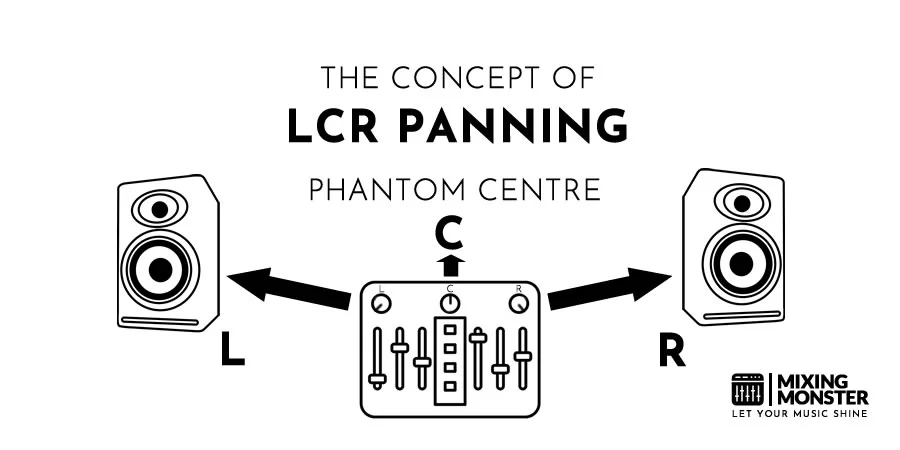
The Science Behind Cardinal Points Panning
Cardinal points panning treats the stereo field as three semi-independent mono mixes. Each position creates distinct psychoacoustic effects for listeners.
Center-panned sounds appear equally in both speakers, creating phantom center imaging. The brain perceives these sounds as coming from between the speakers rather than from either side.
Hard-panned elements utilize the full width of the stereo field. This creates maximum separation between left and right channels while leaving the phantom center clear for vocals and primary instruments.
Stereo Summing Mathematics:
- Center sounds: +6dB boost when summed to mono
- Hard-panned sounds: 6dB reduction relative to center
- Intermediate panned sounds: Variable level changes
The level differences occur because center sounds are equally present in both channels. When summed to mono, they combine constructively while hard-panned elements maintain their original level. Practicing mixing in mono helps engineers identify these level jumps early in the process.
LCR Versus Traditional Panning Methods
Traditional stereo mixing utilizes the complete left-right spectrum for instrument placement. Engineers position sounds at any point between hard left and hard right using percentage values or continuous pan controls.
Conventional panning wisdom dictates that tracks should be placed anywhere in the left-right panorama, except for essential elements like kick drums and vocals. This approach offers flexibility but can create congested mixes.
Traditional Panning Characteristics:
- Full spectrum usage: 0% to 100% positioning available
- Gradual separation: Subtle positioning differences
- Complex mono translation: Variable level relationships
- Potential congestion: Overlapping frequency ranges
LCR panning creates more dramatic separation between elements. The technique prevents the "directionless mess" that can result from overusing intermediate pan positions in dense arrangements.
Mono compatibility becomes more predictable with LCR mixing. Engineers know exactly how each position will translate when the stereo mix collapses to mono playback.
When To Choose LCR Over Conventional Techniques
LCR panning works especially well for dense mixes and obtaining significant width. Complex arrangements benefit from the forced separation that cardinal points provide.
Dense rock and metal productions utilize LCR effectively for guitar layering. Engineers can place rhythm guitars hard left and right while keeping bass and vocals centered for clarity.
Ideal LCR Applications:
- Dense arrangements: Multiple competing instruments
- Mono compatibility priority: Radio and streaming concerns
- Clarity over subtlety: Direct, powerful presentations
- Beginner mixing: Simplified decision-making process
Electronic music producers often avoid LCR when subtle spatial movement enhances the artistic vision. Ambient and orchestral genres may require more nuanced positioning than three points allow.
The technique reveals arrangement problems quickly. If elements don't work in LCR positions, the underlying recording or composition likely needs adjustment rather than mixing solutions. This clarity is often most apparent when mixing in mono, as phase and arrangement issues become impossible to ignore.

2
Essential LCR Panning Techniques For Professional Results
LCR panning creates maximum width by restricting instruments to hard left, center, or hard right positions rather than intermediate locations. Engineers achieve professional results by applying strategic hard panning for impact while maintaining proper frequency separation across the stereo field.

Hard Panning Strategies For Maximum Impact
Professional engineers use hard left and hard right positions to create dramatic stereo width without compromising mono compatibility. Utilizing a hard pan on double-tracked guitars works exceptionally well, creating a wall of sound that maintains clarity.
Percussion elements like hi-hats, shakers, and tambourines benefit from hard panning to opposite sides. This creates rhythmic interest and prevents these elements from cluttering the center channel.
Opposition panning creates balance across the stereo field. When placing a prominent instrument hard left, engineers typically balance it with another element hard right to prevent the mix from feeling lopsided.
Backing vocals respond well to hard panning, especially when recorded as separate takes. This technique keeps them out of the lead vocal's way while adding width to the vocal arrangement.
Center Channel Element Placement Rules
The center channel serves as the foundation for most professional mixes. Kick drums, bass guitars, lead vocals, and snare drums typically occupy this prime real estate due to their structural importance.
Lead instruments, such as guitar solos or saxophone parts, often benefit from center placement. This positioning ensures these elements translate well across all playback systems, from mono club speakers to high-end stereo systems.
Low-frequency instruments require center placement to maintain proper bass response. Panning bass instruments to either side can create phase issues and uneven low-end response across different listening environments.
Vocal doubles and harmonies can occupy the center when they need to blend seamlessly with the lead vocal. This creates density without competing with hard-panned elements for attention.
Discover Best Audio Gear & Equipment


Creating Width Without Losing Focus
Engineers achieve width by strategically placing instruments rather than filling every available pan position. The spaces between hard-panned elements and the center create the perception of a wide, open mix.
Reverb and delay returns can enhance width when panned in the opposite direction from their source material. A center-vocal with hard-right reverb creates spatial interest without sacrificing vocal clarity.
Complementary frequency content helps maintain focus when using wide panning. High-frequency percussion panned hard left balances well with mid-frequency instruments panned hard right.
Dynamic panning movements, such as bringing elements from the sides to the center during choruses, create excitement while maintaining the LCR framework's structural integrity.
Frequency-Based LCR Decision Making
High-frequency instruments like cymbals, bells, and acoustic guitar picking respond well to hard panning. These elements cut through the mix effectively from extreme positions without masking other instruments.
Mid-frequency instruments require careful consideration in panning decisions. Electric guitars, keyboards, and brass instruments can occupy any of the three positions depending on their role in the arrangement.
Frequency overlap between panned elements can cause masking even when they are positioned on opposite sides. Engineers use EQ to carve distinct frequency spaces for each element regardless of pan position.
Low- to mid-range content benefits from center placement to maintain clarity and punch. Instruments with significant energy between 100 and 400 Hz often sound more powerful and defined when placed in the center channel.
3
Instrument Placement Guide For LCR Mixing
Strategic instrument placement forms the foundation of an effective LCR mix, with each element requiring specific positioning to maximize clarity. This method is an essential part of a modern mixing arsenal for achieving optimal separation and impact.
The key lies in understanding which instruments benefit from center placement versus hard panning to create optimal separation and impact. Decisions made as early as the recording stage can influence how these tracks are eventually positioned.
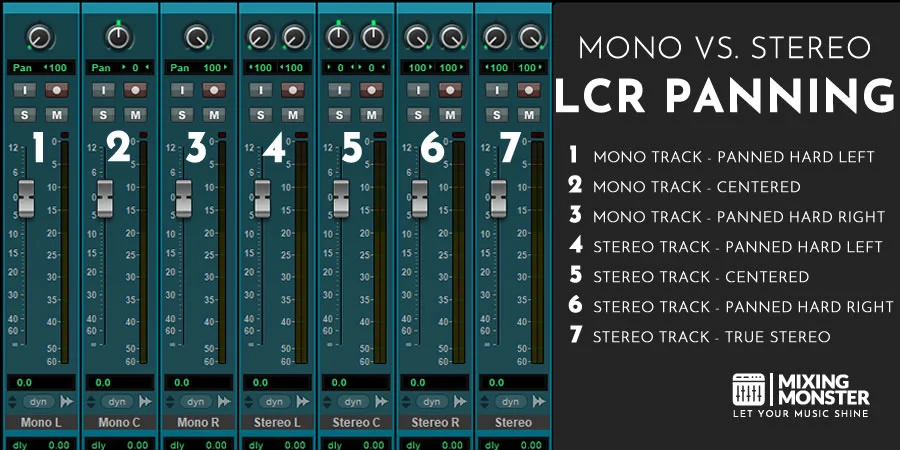
Drum Kit LCR Positioning Strategies
The drum kit serves as the rhythmic anchor in LCR mixing, with fundamental elements typically positioned in the center channel. Kick drums and snare drums should remain centered to maintain their power and punch throughout the mix.
LCR mixing techniques recommend keeping heavy low-end sounds centered to avoid muddying the mix. This principle applies directly to kick drums, which provide the essential low-frequency foundation.
Toms and cymbals offer more flexibility in LCR positioning. Floor toms can be panned hard left or right, depending on the arrangement, while rack toms may be placed in the opposite channel for balance.
Hi-hats typically work well when panned hard left or right, as they contain primarily high-frequency content that won't interfere with centered elements. Overhead microphones capture the entire kit's ambiance and can be split between left and right channels.
Room microphones should be positioned on the outer channels to create width and depth. This approach allows the drum kit's natural stereo image to emerge while maintaining the focused impact of the centered kick and snare.
Guitar And Bass Placement Techniques
Bass instruments require center positioning in LCR mixing due to their low-frequency content and foundational role in the arrangement. Panning bass signals to either side can create phase issues and reduce the overall power of the mix.
Electric guitars benefit significantly from hard panning, especially when multiple guitar parts are present in the same song. Dueling guitar techniques like those heard in AC/DC's "Back in Black" demonstrate how hard-panned guitars can complement rather than compete with each other.
Rhythm guitars should be doubled in opposite channels to create width without frequency masking. Lead guitar parts may remain centered during solos for maximum impact, then return to side positions during verses or choruses.
Acoustic guitars can be positioned on either side channel, particularly when they serve as supporting elements rather than primary melodic components. Guitar effects like reverb tails and delays can be sent to the opposite channel from the dry signal to create additional width.
Your Song Mixed & Mastered By Mixing Monster


Vocal And Lead Instrument Centering
Lead vocals must remain centered in LCR mixing to ensure maximum clarity and presence. This positioning allows vocals to cut through the arrangement without competing with other elements for space.
Backing vocals and harmonies should be positioned hard left or right to create contrast with the lead vocal. This separation allows each vocal layer to be heard distinctly while supporting the main melodic line.
Vocal emphasis techniques include duplicating the main vocal and panning copies to both outer channels for choruses or climactic sections. This creates a wide, powerful effect that draws attention to important lyrical moments.
Lead instruments like piano, synthesizer leads, or prominent melodic lines typically occupy the center channel alongside vocals. When multiple lead elements compete for center space, automation can temporarily move less critical parts to side positions.
Pad sounds and sustained synthesizer textures work effectively when panned to outer channels, providing harmonic support without interfering with centered lead elements.
Supporting Elements And Texture Sounds
Atmospheric elements and sound design components benefit from hard left or right positioning in LCR mixing. These supporting sounds create sonic interest without competing with primary musical elements.
String sections and orchestral pads can be split between left and right channels to create natural width. Individual string voices may be assigned to specific sides based on their role in the harmonic structure.
Percussion elements like shakers, tambourines, and auxiliary instruments typically work well on outer channels. Their high-frequency content and rhythmic nature complement the centered drum foundation.
Keyboard and synthesizer parts require strategic placement based on their frequency content and musical function. Lower-register parts should remain centered or receive high-pass filtering before side placement to avoid muddying the mix.
Effect returns from reverbs and delays can be positioned opposite their source signals to maximize stereo width while maintaining the dry signal's intended placement within the LCR framework.

4
Advanced LCR Panning Applications And Creative Uses
Professional mixing engineers leverage LCR panning techniques beyond basic positioning to create sophisticated spatial arrangements. These advanced applications involve genre-specific strategies, automated movement, arrangement-dependent approaches, and integration with spatial processing.

Genre-Specific LCR Approaches
Rock and metal mixing relies heavily on LCR positioning for maximum impact and clarity. Rhythm guitars occupy hard left and right positions while lead vocals, bass, and kick drums anchor the center channel.
Electronic music producers use LCR panning to separate synthesizer layers and percussion elements. Low-frequency synths remain centered while arpeggiated sequences and percussion fills move to the outer positions.
Hip-hop engineers often place vocals dead center with ad-libs and doubles positioned left or right. Drum samples frequently use hard panning while melodic elements fill the outer stereo field.
Jazz and acoustic recordings benefit from LCR approaches that mimic the natural instrument positioning. Piano sits center-left, bass remains centered, and horn sections spread across left and right positions based on ensemble arrangement.
Dynamic LCR Movement And Automation
Automated LCR transitions create movement within otherwise static mixes. Vocals can shift from center to left during verses, then return to center for choruses, adding rhythmic interest without cluttering the stereo field.
Common automation patterns include:
- Percussion elements jumping between left and right positions
- Lead instruments moving from center to outer positions during solos
- Backing vocals alternating between left and right channels
- Effects return sweeping across the three primary positions
Dynamic movement works particularly well with delay throws and reverb tails. The original signal maintains its LCR position while processed versions appear in different locations.
Related Articles


LCR In Different Musical Arrangements
Dense arrangements require strategic LCR placement to maintain clarity between competing elements. String sections are split between left and right, while lead melodies occupy the center position.
Sparse arrangements benefit from wider LCR spacing to fill the stereo field. Fewer elements mean each position carries greater weight in the overall balance.
Arrangement considerations:
| Element Type | Typical LCR | Reasoning |
|---|---|---|
| Lead vocals | Center | Focus and clarity |
| Bass instruments | Center | Low-frequency stability |
| Rhythm guitars | Left/Right | Stereo width |
| Percussion fills | Left/Right | Movement and interest |
Orchestral arrangements often mirror actual seating positions with strings left, brass right, and woodwinds filling center-left positions.
Combining LCR With Spatial Effects
Spatial effects processing enhances LCR positioning without compromising the fundamental structure. Reverb sends from left and right channels create depth while maintaining positional clarity.
Stereo delays work effectively with LCR sources when the delay taps are placed in positions opposite to the dry signal. Left-panned sources generate right-side delays and vice versa.
Chorus and modulation effects applied to LCR-positioned elements add width without destroying the core positioning. The processed signal occupies the same general location while gaining stereo movement.
Effective spatial combinations:
- LCR dry signals with opposing reverb returns
- Centered sources with wide stereo modulation
- Hard-panned elements with subtle stereo delays
- Static LCR positions with moving effect tails
Stereo imaging plugins can enhance existing LCR mixes by adding subtle width to centered elements or tightening overly wide stereo sources without changing their fundamental positions.

5
Common LCR Panning Mistakes And How To Avoid Them
LCR panning mistakes typically stem from overloading the center channel with too many elements and ignoring how the mix translates to mono playback. Engineers also frequently make poor hard panning decisions that create imbalanced stereo images and introduce phase issues between related tracks.
Over-Crowding The Center Channel
Many engineers instinctively place too many elements in the center channel when first adopting LCR techniques. This creates a congested phantom center that lacks clarity and definition. Mixing in mono often reveals whether your mixing decisions are causing too many elements to fight for the same central space.
The center channel should primarily contain foundational elements like kick drum, snare, bass, and lead vocals. These core elements anchor the mix and provide the rhythmic and melodic foundation listeners expect.
Secondary instruments like rhythm guitars, keyboards, and percussion should be distributed to the left and right channels. This distribution prevents frequency masking and allows each element breathing room in the stereo field.
Elements for Center Channel:
- Lead vocals
- Bass guitar/synth bass
- Kick drum
- Snare drum
- Primary lead instruments
Elements for Left/Right Channels:
- Rhythm guitars
- Background vocals
- Percussion elements
- Synthesizer pads
- Secondary melodic instruments
When multiple mono tracks compete for center placement, engineers must make decisive choices about which elements deserve to be placed there. The remaining tracks should be strategically placed left or right based on their importance and frequency content.
Neglecting Mono Compatibility Issues
LCR panning can cause significant changes in mix balance when summed to mono, yet many engineers fail to check mono compatibility during mixing. Hard-panned elements become 6dB quieter relative to center-panned sounds in mono playback.
This level difference affects the perceived balance between instruments. Guitars panned hard left and right will sound noticeably quieter compared to the centered bass and vocals when the mix collapses to mono.
Regular mono checking reveals these balance shifts before they become problematic. Engineers should toggle between stereo and mono frequently, especially when setting initial levels and making EQ decisions. Incorporating mixing in mono into your routine ensures that the hard left and hard right signals don't disappear in single-speaker environments.
Mono Compatibility Checklist:
- Check relative levels between the center and side elements
- Verify bass/kick relationship remains intact
- Ensure lead vocals maintain prominence
- Test that rhythm elements still provide adequate drive
Stereo reverb and ambience effects often disappear entirely in mono playback. Engineers should supplement stereo effects with mono reverb sends to maintain spatial character when the mix translates to single-speaker systems.
The frequency relationships between hard-panned and centered elements become more critical in mono. High-pass filtering on wide guitars prevents low-frequency conflicts with the centered bass, maintaining clarity in both stereo and mono formats.
Inappropriate Hard Panning Choices
Poor hard panning decisions create unbalanced stereo images and listener fatigue. Some instruments naturally lend themselves to hard panning, while others require more careful placement.
Suitable for Hard Panning:
- Double-tracked guitars (opposite sides)
- Percussion elements (shakers, tambourines)
- Background vocal harmonies
- Synthesizer arpeggios or sequences
Problematic Hard Panning:
- Solo melodic instruments without counterbalance
- Wide frequency-range instruments
- Drums (except specific creative applications)
- Bass frequencies below 100Hz
Creating a counterbalance prevents the mix from feeling lopsided when elements occupy only one side. If an important guitar part sits hard left, placing complementary elements hard right maintains stereo equilibrium.
Frequency content affects hard pan choices significantly across the stereo spectrum. Instruments with substantial low-frequency content can create an uneven bass response when panned to extreme positions. Mid-range-focused instruments typically handle hard panning more effectively.
Dynamic elements require special consideration in LCR setups. A guitar solo panned hard right might sound impressive initially, but it can become fatiguing during extended listening sessions.
Phase Problems In LCR Setups
LCR panning can mask phase relationships between related tracks, leading to mono compatibility issues and tonal inconsistencies. Phase problems become particularly apparent when the stereo mix collapses to mono.
Double-tracked guitars panned hard left and right may sound wide and impressive in stereo, but they partially cancel each other in mono if the phase alignment is poor. This cancellation reduces the guitars' impact and significantly alters their tonal character.
Common Phase Problem Sources:
- Improperly aligned double-tracked performances
- Multiple microphones on a single source
- Processing delays between related tracks
- Chorus or modulation effects on paired elements
Checking phase relationships requires careful mono monitoring during recording and mixing. Engineers should ensure that paired elements maintain their character and level when summed to mono.
Phase Alignment Techniques:
- Time-align related tracks using delay compensation
- Check polarity on multiple microphone recordings
- Use correlation meters to identify phase issues
- Apply gentle high-pass filtering to reduce low-frequency phase interactions
Stereo effects processing can introduce phase shifts that become problematic in LCR configurations. Chorus, flangers, and some reverbs create phase modifications.

6
LCR Panning Tools And Software Recommendations
Professional LCR panning requires precise tools that enable accurate positioning and monitoring. Digital audio workstations provide basic panning controls, while specialized plugins and hardware controllers offer enhanced precision for dedicated LCR workflows.
Essential Panning Plugins For LCR Work
Most digital audio workstations include standard pan controls that work effectively for LCR positioning. Logic Pro X, Pro Tools, and Cubase offer precise pan positioning with their built-in controls.
Waves S1 Stereo Imager provides visual feedback for stereo positioning decisions. The plugin clearly displays stereo width and phase relationships.
FabFilter Pro-Q 3 includes mid-side EQ, an essential feature for LCR mixing. Engineers can adjust frequency content in the center channel independently of the sides.
Plugin Alliance bx_solo offers advanced solo and mute functions for LCR work. The plugin enables quick switching between stereo and mono monitoring.
Many engineers prefer plugins with visual metering for LCR verification. Voxengo SPAN and iZotope Insight 2 display stereo field information in real-time.
Hardware Controllers For Precise Positioning
Avid Artist Mix provides dedicated pan pots for each channel. The controller offers tactile feedback that software-only solutions cannot match.
SSL UF8 includes high-resolution pan controls with center detents. The hardware maintains consistent pan law settings across all channels.
Mixing consoles with three-position pan switches replicate classic LCR workflows. Vintage consoles like the Neve 1073 featured only discrete left-center-right positioning.
Modern controllers, such as the Mackie MCU Pro, offer motorized pan controls. The faders return to saved positions automatically during recall.
PreSonus FaderPort series provides affordable pan control options. Single-channel controllers work well for focused LCR adjustments.
Monitoring Setup For LCR Decision Making
Near-field monitors positioned at 60-degree angles provide optimal LCR imaging. Yamaha NS-10M and KRK Rokit series work effectively for LCR evaluation.
Studio engineers require mono monitoring capability for LCR verification. A dedicated mono switch immediately reveals phase issues and level imbalances.
Reference monitors help confirm that LCR decisions are properly translated. Multiple speaker systems reveal how LCR choices perform across different playback environments.
Room acoustics significantly impact LCR perception. Acoustic treatment at first reflection points improves stereo imaging accuracy.
Headphone monitoring provides an alternative perspective for LCR positioning. Open-back models like Sennheiser HD 650 offer a natural stereo presentation.
Analysis Tools For LCR Verification
Correlation meters display mono compatibility in real-time. Values near +1 indicate good mono translation, while negative values suggest phase problems.
Goniometers effectively visualize the distribution of the stereo field. The circular display clearly shows signal positioning across the left-right spectrum.
Pan law settings significantly affect the relationships between LCR levels. -3dB pan law maintains consistent perceived levels during panning movements.
| Tool Type | Key Feature | Recommended Use |
|---|---|---|
| Correlation Meter | Phase relationship | Mono compatibility check |
| Goniometer | Stereo field display | Visual LCR verification |
| Spectrum Analyzer | Frequency distribution | Balance assessment |
Multi-channel analyzers like NuGen Audio VisLM provide comprehensive LCR analysis. These tools display level, phase, and frequency information simultaneously.
Software like Melda MMultiAnalyzer offers detailed stereo field analysis. The plugin shows the precise positioning of individual elements within the LCR framework.

7
Key Takeaways For LCR Panning Mastery
Master the Three-Position Rule: LCR panning limits all elements to hard left, center, or hard right positions. This constraint forces decisive mixing decisions and eliminates the confusion of an infinite number of pan positions.
Center Your Star Elements: Place priority sounds like lead vocals, kick drums, snare, and bass in the center channel. These foundational elements anchor the mix and provide mono compatibility.
Keep Low Frequencies Centered: Heavy low-end content works best in the center position. Panning bass-heavy elements hard left or right can muddy the mix and reduce impact.
Use Hard Panning for Separation: Hard-panned guitars, toms, hi-hats, and atmospheric elements create width without cluttering the center. This approach allows dueling instruments to complement rather than compete with one another.
Apply High-Pass Filtering: EQ hard-panned signals to remove unnecessary low frequencies. This prevents mud buildup in the left and right channels while maintaining clarity.
Build Vocal Contrast: Center the lead vocal while sending harmonies, backing vocals, and ad-libs to the hard positions. This creates a clear hierarchy and separation between vocal layers.
Leverage Automation: Move elements between LCR positions using automation to create emphasis and movement. Even with limited positions, dynamic panning adds interest to sections.
Consider Genre Applications: LCR panning works particularly well in rock, metal, and dense arrangements where clarity and power are priorities.
Happy LCR panning!

Frequently Asked Questions
1
How does LCR panning enhance stereo imaging in a mix?
LCR panning creates wider stereo imaging by utilizing hard left and right positions alongside center placement. This approach maximizes the available stereo field by placing elements at the extremes rather than clustering them in intermediate positions.
The technique produces clearer phantom center imaging. When instruments occupy only the three cardinal positions, the spaces between them remain uncluttered, allowing listeners to perceive each element more distinctly.
LCR panning emphasizes the width of the mix by creating maximum separation between left and right channels. This separation enhances the perceived spaciousness of the stereo field without relying on artificial widening effects.
2
What are the advantages of using LCR panning in modern music production?
The primary advantage lies in improved clarity and focus of the mix. LCR panning forces engineers to make deliberate decisions about instrument importance rather than placing everything in intermediate positions.
This technique maintains excellent mono compatibility. Since elements are either centered or fully panned, the mix translates well when summed to mono playback systems.
LCR panning simplifies mixing by reducing the number of placement options. Engineers spend less time fine-tuning pan positions and more time addressing fundamental mix balance and frequency relationships.
The approach works particularly well for rock and metal productions. Wide opposition-panned distorted guitars create impressive stereo width while maintaining punch and clarity.
3
Can LCR panning be effectively implemented on all types of audio tracks?
Drums respond exceptionally well to LCR treatment. Kick and snare drums benefit from center placement, while toms and cymbals can occupy the left and right positions for maximum impact.
Guitars and bass work effectively with this approach. Bass typically remains centered while guitars can be hard-panned left and right to create width without frequency conflicts.
Vocals and lead instruments are well suited to center positioning in LCR mixes. This placement ensures they remain prominent and focused regardless of playback system configuration.
Some orchestral and ambient music may require more nuanced positioning. Dense arrangements with multiple similar instruments might benefit from intermediate panning positions to create realistic spatial relationships.
4
What are some common pitfalls to avoid when using LCR panning techniques?
The biggest mistake involves using panning solely for separation. Engineers must resist the temptation to rely on hard panning to separate conflicting instruments without addressing underlying frequency or arrangement issues.
Balance problems can emerge with sparse arrangements. When few elements exist in a mix, hard panning one instrument without a counterbalancing element creates an uneven stereo image.
Ignoring mono playback compatibility represents another common error. Engineers must regularly check how hard-panned elements translate when the mix is summed to mono.
Level relationships change significantly in mono playback. Hard-panned elements become 6dB quieter relative to center-panned sounds when the mix is summed to mono.
5
How do professionals utilize LCR panning in conjunction with other mixing tools?
EQ becomes more critical in LCR mixing workflows. Engineers use high-pass filtering on guitars to prevent low-frequency buildup when center-panned bass instruments are used.
Reverb and delay effects help balance asymmetrical panning. Sending hard-panned sources to reverb returns positioned on the opposite side creates better stereo balance while maintaining directional focus.
Compression and dynamics processing work independently of pan position. Engineers apply these tools based on musical requirements rather than stereo placement considerations.
Mid-side EQ techniques complement LCR panning approaches. Engineers can adjust the center and side information separately to fine-tune the balance between focused and wide elements.
6
What are the key differences between LCR and traditional stereo panning?
Traditional stereo panning utilizes the full panoramic field. Engineers place instruments at any position between hard left and hard right, creating gradual transitions across the stereo spectrum.
LCR panning restricts placement to three specific positions. This limitation forces more decisive placement choices and typically results in clearer, more defined stereo imaging.
Intermediate panning positions can create congestion in traditional approaches. Multiple instruments occupying similar pan positions may compete for listener attention, reducing overall clarity.
LCR mixing requires different balance considerations. The technique demands careful attention to how elements relate when summed to mono, while traditional panning allows for more flexible mono translation.