





When you turn up your favorite track and notice how the quiet verses feel just as engaging as the explosive chorus, you're experiencing the power of dynamic range in action. This critical element separates amateur productions from professional masters that captivate listeners.
Dynamic range is the ratio between the loudest and quietest sounds in an audio signal, measured in decibels (dB), and it determines how much variation exists between the softest whispers and the most powerful peaks in a mix.
In audio mastering, dynamic range refers to the difference between the low-level noise floor and the high-level signal saturation. Professional mastering engineers manipulate this range to ensure tracks sound balanced across different playback systems while maintaining the emotional impact of the original performance. The challenge lies in achieving competitive loudness without sacrificing the natural dynamics that make music feel alive and breathing.
Understanding how to control dynamic range transforms good masters into great ones. This guide explores compression techniques, limiter applications, genre-specific approaches, and analysis tools that help engineers make informed decisions. Discover how to avoid the pitfalls of the loudness war, optimize your workflow with advanced strategies, and master the delicate balance between impact and clarity that defines modern audio production.
Key Takeaways / TL;DR
- Dynamic range represents the measurable difference between the quietest and loudest parts of audio, directly affecting perceived quality and emotional impact.
- Compression and limiting are essential tools that shape dynamics but require careful application to prevent lifeless, over-processed results.
- Genre-specific standards and proper analysis techniques guide mastering decisions that balance commercial loudness with musical integrity.

1
Dynamic Range In Audio Mastering: What You Need To Know
Dynamic range represents the difference between the loudest and quietest elements in audio, measured in decibels. Modern mastering engineers balance this range against loudness requirements while accounting for how streaming platforms process and normalize audio content.
Defining Dynamic Range And Its Role In Music Production
Dynamic range in music production measures the decibel difference between the loudest and quietest sounds in an audio file. This measurement determines the amount of space between peak transients and softer passages.
Recording systems and playback equipment also possess their own dynamic range capabilities. The dynamic range of a system spans from the noise floor to the clipping point. Signals below the noise floor become indistinguishable from system noise, while signals exceeding the clipping point experience distortion.
Greater dynamic range indicates less compression and lower overall loudness. Smaller dynamic range reveals more aggressive compression and limiting, pushing the audio closer to maximum loudness levels. This relationship directly affects the tonal range and texture of the final master.
Highly dynamic masters preserve transient detail and allow attacks to punch through the mix. The peaks and valleys of the waveform maintain a significant distance, creating clear separation between loud and quiet moments. More compressed masters reduce this distance, achieving higher average loudness at the cost of transient clarity.
Measuring Dynamic Range Using LUFS And Peak Values
Audio engineers measure dynamic range using multiple metrics that capture different aspects of loudness perception. LUFS (Loudness Units relative to Full Scale) measures perceived loudness based on how the human ear responds to different frequencies. This standard provides more accurate readings than simple peak measurements.
Peak values indicate the highest instantaneous level in an audio file, typically measured in dBFS (decibels relative to Full Scale). The difference between integrated LUFS and true peak values reveals the extent of dynamic variation within a track.
Professional mastering engineers monitor several measurements simultaneously:
- Integrated LUFS: Average loudness across the entire track
- Short-term LUFS: Loudness measured over 3-second windows
- True Peak: Absolute maximum level preventing intersample peaks
- Crest Factor: Ratio between peak and RMS (root mean square) levels
A track with -14 LUFS integrated loudness and -1 dBTP true peak demonstrates different dynamic characteristics than one at -8 LUFS with the same peak value. The quieter track preserves more dynamic range and transient impact.
The Loudness Wars And Modern Mastering Standards
The loudness wars describe a period when mastering engineers progressively reduced dynamic range to achieve louder releases. Heavy limiting and compression squeezed audio signals toward maximum levels, often causing listener fatigue and distortion artifacts.
This practice emerged from the assumption that louder tracks received more radio play and captured listener attention. Engineers reduced the dynamic range to raise the integrated loudness to -8 LUFS or higher. The result sacrificed tonal range and emotional dynamics for sheer level.
Modern mastering has shifted toward preserving dynamics. Engineers now balance loudness with impact rather than maximizing level alone. Professional standards recognize that excessive compression creates listening fatigue and removes the emotional nuance that makes music compelling.
Contemporary masters typically target moderate loudness levels that preserve transients and natural dynamics. This approach maintains the artist's intended emotional content while ensuring competitive loudness.
How Streaming Platforms Handle Dynamic Range
Streaming services apply loudness normalization to create consistent playback levels across different tracks. Spotify, Apple Music, YouTube, and Tidal each normalize audio to specific target levels, fundamentally changing how dynamic range affects the listening experience.
Platform Normalization Targets:
|
Platform |
Target Level |
Limiter Applied |
|
Spotify |
-14 LUFS |
Yes (if louder) |
|
Apple Music |
-16 LUFS |
No |
|
YouTube |
-14 LUFS |
Yes (if louder) |
|
Tidal |
-14 LUFS |
Yes (if louder) |
Tracks mastered louder than the platform target get turned down, negating any loudness advantage gained from heavy compression. This normalization rewards masters that preserve dynamic range. A dynamic master at -14 LUFS plays at full volume on Spotify, while a heavily limited master at -8 LUFS gets reduced by 6 dB.
Some platforms allow users to turn off normalization, but most listeners use default settings. Engineers now optimize masters for streaming by targeting platform-specific loudness levels while maintaining healthy dynamic range. This strategy ensures tracks sound punchy and engaging without unnecessary compression artifacts.

2
Understanding Audio Compression And Its Impact On Dynamic Range
Compression fundamentally alters the relationship between the loudest and quietest parts of an audio signal by reducing the difference between peaks and valleys. The process involves amplifying quiet sounds, attenuating loud sounds, or combining both approaches to achieve specific sonic goals.
Types Of Compression: Upward, Downward, And Parallel
Downward compression reduces the level of signals that exceed a specified threshold, making loud sounds quieter. This is the most common form of compression used in audio production. Downward compression is important for volume control and for preventing peaks from distorting audio hardware.
Upward compression works inversely by amplifying signals below the threshold, bringing quieter elements up in level. This approach increases the average signal loudness while maintaining, or even expanding, its perceived dynamic range. Engineers often use upward compression on dialogue or subtle instrumental parts that need more presence without affecting louder passages.
Parallel compression combines a heavily compressed signal with the original, unprocessed signal. This technique allows engineers to add density and power while preserving the natural dynamics and transients of the source material. The compressed signal adds body and sustain, while the dry signal maintains clarity and punch.
Key Compression Parameters (Threshold, Ratio, Attack, Release)
The threshold determines the signal level at which compression begins to take effect. Setting the threshold too low results in over-compression, while setting it too high may leave dynamic issues unaddressed. Engineers typically adjust the threshold until they achieve 3-6 dB of gain reduction on the loudest peaks.
The ratio controls how aggressively the compressor reduces gain above the threshold. A 2:1 ratio means that for every 2 dB the input exceeds the threshold, the output increases by only 1 dB. Ratios between 2:1 and 4:1 provide gentle compression, while ratios above 10:1 function as limiting.
Attack time defines how quickly the gain reduction is applied once the signal exceeds the threshold. Fast attack times (under 10ms) catch transients immediately but can dull percussive sounds. Slower attack times (20-50ms) allow transients to pass through unaffected, preserving punch and clarity.
Release time determines how quickly the gain returns to normal after the signal drops below the threshold. Improper release settings create "pumping" or "breathing" artifacts that draw attention to the compression itself rather than the music.
Discover Best Audio Gear & Equipment

Serial Compression Techniques For Transparent Control
Serial compression applies multiple compressors in sequence, each performing a small amount of gain reduction rather than forcing a single compressor to work too hard. This approach distributes the workload across several stages, resulting in more transparent dynamic control.
The first compressor in the chain typically uses a moderate ratio (3:1 to 4:1) with a medium-fast attack to catch obvious peaks. It might apply 2-3 dB of gain reduction on the loudest material. The second compressor uses gentler settings with a higher threshold, contributing an additional 1-2 dB of gain reduction.
This staged approach prevents any single compressor from introducing audible artifacts. Each compressor operates within its optimal range, maintaining the natural character of the source material. Serial compression is particularly effective on vocals, bass, and mix bus processing, where consistent levels are crucial, but transparency must be maintained.
Engineers often combine different compressor types in series to leverage their unique characteristics. An optical compressor might provide smooth, musical gain reduction in the first stage, while a VCA compressor adds precise control in the second stage.
Common Compression Mistakes That Destroy Dynamics
Setting attack times too fast eliminates transients, making instruments sound dull and lifeless. Drums lose their impact, guitars lack definition, and vocals sound squashed. Engineers should allow at least some transient information to pass through uncompressed to maintain energy and excitement.
Excessive gain reduction flattens the natural expression and emotional content of a performance. When compression consistently exceeds 6-8 dB of gain reduction, the result sounds over-processed and artificial. The performance loses its human quality and dynamic variation.
Improper release times create obvious pumping effects where the compressor audibly reacts to the music. Too-fast release times cause the compressor to chase every dynamic change, creating distortion and instability. Too-slow release times prevent the compressor from recovering between notes, resulting in sustained gain reduction that dulls the overall sound.
Neglecting to consider the makeup gain relationship between compressed and uncompressed signals leads engineers to mistake loudness for quality. A compressed signal often sounds "better" simply because it's louder, not because the compression improved the sound. A/B comparisons at matched volumes reveal whether compression truly enhances the audio or merely increases its level.
3
Mastering Limiters And Their Effect On Dynamic Content
Limiters function as specialized compressors that establish absolute ceilings for audio levels while shaping how dynamic content translates in the final master. The distinction between peak types, ceiling configurations, timing parameters, and frequency-based processing determines whether dynamic material retains its musical character or becomes flattened and lifeless.

Peak Limiting Versus True Peak Limiting
Standard peak-limiting measures and controls sample peaks in the digital domain. True peak limiting addresses inter-sample peaks that occur between sample points and can cause distortion when audio undergoes format conversion or codec processing.
True peak limiting becomes essential for streaming platforms and broadcast distribution. Digital-to-analog conversion can create peaks exceeding 0 dBFS even when the digital file shows no clipping. True peak meters measure these inter-sample peaks using oversampling to detect potential distortion before it occurs.
Most modern limiters include true peak detection, with recommended ceiling settings of -1.0 dBTP for streaming services. Standard peak limiting suffices only when the audio remains entirely in the digital realm without conversion.
Setting Proper Limiter Ceiling And Output Levels
The output ceiling determines the absolute maximum level the limiter permits. Setting this ceiling at -0.3 dB to -1.0 dB provides headroom for codec artifacts and prevents distortion during playback. Different distribution platforms require specific ceiling levels to avoid automatic gain reduction.
Streaming services normalize content to target a loudness range of -14 to -16 LUFS. Pushing a limiter ceiling too close to 0 dB creates no competitive advantage when platforms reduce the level anyway. The ceiling should account for the material's true peak behavior and final destination.
Input gain or threshold controls the amount of limiting. Gain reduction meters show real-time processing intensity. Excessive gain reduction above 3-5 dB indicates over-limiting that compresses dynamics excessively and introduces audible artifacts.
Your Song Mixed & Mastered By Mixing Monster


Lookahead Time And Release Settings For Natural Sound
Lookahead functionality allows the limiter to analyze incoming audio up to milliseconds before processing. This preview enables smoother gain reduction on transients without requiring extremely fast attack times that create distortion.
Typical lookahead values range from 0.5 ms to 10 ms. Longer lookahead times produce cleaner transient handling but introduce system latency. Material with sharp percussion benefits from 3-5 ms of lookahead, while sustained content works with shorter settings.
Release time determines how quickly the gain reduction returns to zero after a peak passes. Fast release times between 50 and 100 ms maintain energy but risk creating pumping artifacts. Slower releases above 200 ms sound more transparent but can suppress subsequent transients if peaks occur in rapid succession.
Auto-release functions adapt timing based on the program material's characteristics. These intelligent algorithms balance transparency and peak control without manual adjustment.
Multiband Limiting For Frequency-Specific Control
Multiband limiters split the audio spectrum into separate frequency bands, applying independent limiting to each. This approach prevents excessive bass energy from triggering gain reduction that affects the entire mix.
A typical configuration divides audio into three to five bands. Low frequencies receive gentler limiting to preserve punch, while mid and high frequencies can handle more aggressive processing. The crossover frequencies should align with the musical content's natural divisions.
Band Configuration Example:
|
Frequency Range |
Limiting Intensity |
Purpose |
|
20-200 Hz |
Light (1-2 dB) |
Preserve bass impact |
|
200-2000 Hz |
Moderate (2-3 dB) |
Control midrange density |
|
2000-8000 Hz |
Moderate (2-4 dB) |
Manage vocal and lead elements |
|
8000-20000 Hz |
Light (1-2 dB) |
Maintain air and sparkle |
Multiband processing requires careful monitoring. Excessive band separation creates phase issues and unnatural frequency balance. Single-band limiting maintains better phase coherence for most materials, while multiband serves specific corrective purposes when certain frequencies dominate excessively.

4
Genre-Specific Dynamic Range Best Practices
Different music genres require distinct approaches to dynamic range management based on their sonic characteristics and listener expectations. Modern genres like rock, pop, and rap typically feature smaller dynamic ranges compared to classical music, while jazz occupies a middle ground between contemporary and traditional styles.

Dynamic Range Targets For Electronic And Dance Music
Electronic and dance music producers typically aim for dynamic ranges between 4-8 dB to maintain consistent energy on club sound systems. The kick drum and bass elements demand careful compression during tracking, mixing, and mastering to ensure they punch through without creating excessive peaks.
Sidechain compression serves as a fundamental technique in this genre. It creates rhythmic pumping effects while preventing low-frequency buildup that can muddy the mix.
Peak limiters should be set conservatively to avoid distortion, with most tracks staying between -8 and -6 LUFS for streaming platforms. Transient designers help shape drum hits without sacrificing overall loudness.
Automation of filter sweeps and volume rides adds perceived dynamics even within compressed material. This technique maintains listener engagement throughout extended arrangements typical of dance tracks.
Preserving Dynamics In Rock And Metal Productions
Rock and metal engineers face the challenge of delivering power while maintaining clarity across dense arrangements. Guitar-driven productions benefit from dynamic ranges of 8-12 dB, allowing choruses to explode relative to verses without sacrificing punch.
Parallel compression preserves transient information in drum recordings while adding sustained weight. Engineers typically blend an aggressively compressed duplicate of the original signal with the original to achieve both impact and natural feel.
Multiband compression addresses specific frequency ranges independently. This approach prevents muddy low-mids while controlling harsh high frequencies common in distorted guitars.
Critical elements to preserve:
- Drum transients, especially snare cracks
- Vocal dynamics during emotional peaks
- Clean guitar passages that contrast with heavy sections
- Bass definition beneath distorted guitars
The verse-chorus dynamic contrast defines successful rock productions. A difference of 3-6 dB between sections creates satisfying energy shifts.
Related Articles
Classical And Jazz Mastering: Maximum Dynamic Preservation
Classical and orchestral recordings require the widest dynamic ranges, often exceeding 20 dB to capture the full expressive range of acoustic instruments. Chamber, opera, orchestral, and piano music maintain significantly larger dynamic ranges than contemporary genres.
Minimal compression during mastering preserves the natural dynamics that performers worked to achieve. Light limiting at -1 dB true peak prevents digital clipping while maintaining artistic intent. Room acoustics play a crucial role in these recordings, with natural reverb providing depth without artificial enhancement.
Jazz productions fall between classical and modern approaches, typically maintaining 12-18 dB of dynamic range. Soloists need space to build intensity naturally, while rhythm sections provide consistent foundations without excessive compression.
Engineers working in these genres prioritize microphone placement and gain staging over corrective processing. The goal remains transparent capture rather than creative manipulation of dynamics.
Hip-Hop And Pop: Balancing Punch With Clarity
Hip-hop and pop productions demand immediate impact while maintaining vocal intelligibility across diverse playback systems. These genres typically target 6-10 dB dynamic ranges with vocals sitting prominently above instrumental tracks.
Vocal compression chains often include multiple stages: a gentle compressor catching peaks, followed by a limiter for consistency. This approach maintains natural expression while ensuring presence in dense arrangements.
Beat elements receive individual dynamic treatment:
|
Element |
Compression Ratio |
Attack Time |
|
Kick |
4:1 to 8:1 |
5-10 ms |
|
Snare |
3:1 to 6:1 |
1-5 ms |
|
Bass |
4:1 to 6:1 |
10-30 ms |
|
Vocals |
3:1 to 4:1 |
5-15 ms |
De-essing prevents harsh sibilance without dulling vocal presence. Balancing loudness with dynamics ensures tracks compete on streaming platforms while retaining listener engagement through subtle dynamic variation.
Automation enhances perceived dynamics by riding vocal levels and emphasizing hook sections. This technique creates movement within otherwise compressed material, preventing listener fatigue during repeated playback.

5
Tools And Techniques For Analyzing Dynamic Range
Accurate dynamic range analysis requires specialized metering tools that measure loudness variations, combined with systematic comparison methods that reveal how a mix responds to processing. These techniques provide objective data that helps audio professionals make informed mastering decisions.
Essential Metering Plugins For Dynamic Analysis
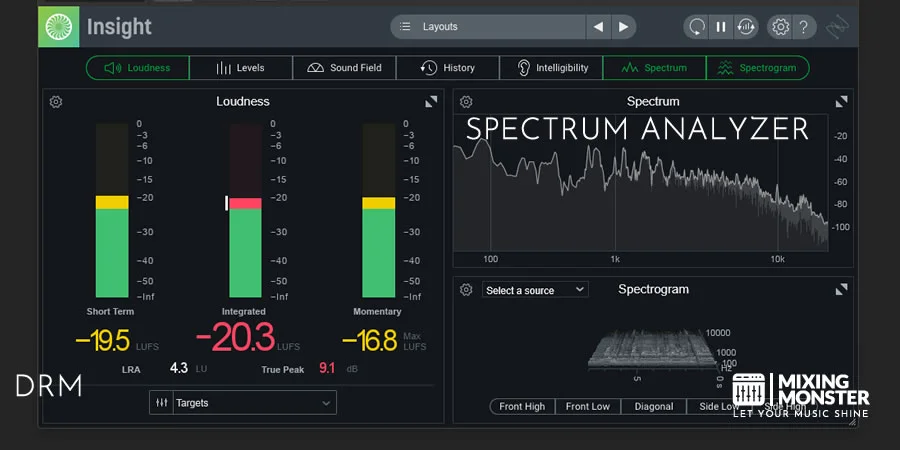
Dynamic range meters display the difference between the loudest and quietest parts of an audio signal in real-time. Plugins like Youlean Loudness Meter, TT Dynamic Range Meter, and iZotope Insight 2 provide both instantaneous and integrated measurements that track dynamic changes throughout a track.
Most professional metering tools display several key metrics simultaneously. The Peak-to-RMS ratio shows the relationship between transient peaks and average loudness. Crest factor measurements indicate the amount of headroom between average levels and peaks. LRA (Loudness Range) values quantify the variation in loudness over time.
Color-coded histograms in many plugins visualize how much time the audio spends at different loudness levels. Green zones typically indicate healthy dynamics, while yellow and red zones show potential compression. The visual feedback helps identify sections where dynamics have been reduced too aggressively.
Free options like dpMeter and Orban Loudness Meter provide basic DR measurements that are sufficient for most mastering tasks. Paid plugins often add features such as true-peak detection, offline analysis modes, and batch processing for analyzing multiple files.
Reading And Interpreting Loudness Range (LRA) Measurements
LRA measures the variation between soft and loud passages in a program, expressed in Loudness Units (LU). A wider LRA indicates greater dynamic variation, while a narrow LRA suggests heavy compression or limiting has been applied.
Broadcast standards define specific LRA targets for different content types. Film content typically ranges from 15 to 20 LU, providing significant dynamic contrast. Music recordings usually fall between 4 and 8 LU for modern pop and rock, while classical music often exceeds 15 LU. Podcasts and spoken word content generally measure 6-12 LU.
The measurement excludes the quietest 10% and loudest 5% of the signal to focus on the musically relevant dynamic range. This gating prevents silence and occasional peaks from skewing the results. A track with an LRA of 3 LU or less sounds heavily compressed, while values above 12 LU typically indicate minimal dynamic processing.
Context matters when evaluating LRA numbers. A 5 LU reading might be appropriate for an energetic rock track but would indicate excessive compression for a jazz ballad.
Using Reference Tracks To Guide Your Mastering Decisions
Reference tracks provide benchmarks for dynamic range decisions by offering comparison points from professionally mastered recordings. Engineers select references that match the genre, mood, and intended loudness of their project.
Loading reference tracks into a DAW session allows direct A/B comparison using matched playback levels. Setting both the working track and reference to the same integrated loudness (typically -14 LUFS for streaming) ensures fair comparison. The perceived punch and clarity differences become immediately apparent when levels are matched.
Analyzing reference tracks with metering plugins reveals their dynamic characteristics. Engineers note the peak levels, RMS values, and LRA measurements to establish target ranges. A reference with 6 LU of dynamic range and -8 dBTP peak levels provides specific goals rather than vague aesthetic descriptions.
Multiple references covering slight variations in approach help avoid slavishly copying a single track. Three to five references create a target zone rather than a single point, allowing creative flexibility while maintaining commercial competitiveness.
A/B Testing Methods For Dynamic Comparison
Systematic A/B testing isolates the effects of dynamic processing by controlling variables and rapidly switching between versions. The comparison reveals whether compression enhances or diminishes the musical impact.
Level-matched testing prevents louder versions from seeming automatically better due to the Fletcher-Munson effect. Engineers reduce the output of compressed versions to match the uncompressed peaks or integrated loudness. Many mastering engineers use these comparison steps:
- Bounce versions with different compression settings
- Match integrated loudness using a gain plugin
- Switch between versions every 15-30 seconds
- Focus on specific musical elements (drums, vocals, bass)
- Document preferences with written notes
Blind testing removes confirmation bias by having an assistant randomize the versions. The engineer rates each version without knowing which processing was applied, then reveals the settings afterward. This method often produces surprising results that challenge initial assumptions.
Rest periods between listening sessions prevent ear fatigue from distorting judgment. Taking 10-minute breaks allows the auditory system to reset, making subsequent comparisons more reliable. Fresh ears catch subtleties that become masked during extended sessions.

6
Advanced Strategies For Optimizing Dynamic Range
Mastering engineers rely on precise gain staging, controlled saturation, stereo-field processing, and targeted automation to shape dynamics without sacrificing clarity or punch. These techniques work together to maximize detail retention while maintaining consistent loudness across different playback systems.
Gain Staging Throughout Your Mastering Chain
Proper gain staging ensures each processor in the mastering chain receives optimal signal levels for clean processing. Engineers should aim for -18 dBFS to -12 dBFS at input stages to prevent digital clipping while maintaining sufficient headroom.
Each plugin or hardware unit introduces its own noise floor and distortion characteristics. Setting input levels too low raises the noise floor relative to the signal, while excessive levels cause unwanted saturation or clipping. Monitoring levels between processing stages reveals where gain adjustments are needed.
Peak meters alone don't tell the complete story. RMS and LUFS measurements provide better insight into perceived loudness and help maintain consistent levels throughout the chain. Most mastering-grade processors include internal metering to verify proper gain structure.
Digital systems benefit from leaving 3-6 dB of headroom before the final limiter. This buffer accommodates intersample peaks and prevents converter distortion during digital-to-analog conversion.
Utilizing Saturation And Harmonic Distortion Tastefully
Analog-style saturation adds harmonics that can enhance perceived fullness without drastically reducing dynamic range. Tape saturation emulations typically add even-order harmonics that sound warm and musical when applied subtly.
Types of saturation for mastering:
- Tape saturation: Adds warmth and gentle compression
- Tube saturation: Creates even-order harmonics for smoothness
- Transformer saturation: Provides thickness in midrange frequencies
- Subtle clipping: Rounds off transient peaks minimally
The key lies in applying saturation at levels below audible distortion thresholds. Settings that add 0.5-2% total harmonic distortion typically enhance material without obvious coloration. Engineers often parallel process saturation, blending 10-30% of the affected signal with the clean signal.
Different frequency ranges respond differently to saturation. Low frequencies handle more aggressive saturation, while high frequencies become harsh quickly. Multiband saturation plugins allow independent control across the spectrum.
Mid-Side Processing For Enhanced Dynamic Control
Mid-side processing separates center and stereo information, enabling independent dynamic control of each component. This technique proves valuable when the center channel contains dense elements like vocals and bass, while the sides hold ambiance and supporting instruments.
Applying compression to the mid channel while leaving the sides untouched maintains spaciousness during loud passages. Conversely, compressing only the sides can control reverb and room tone without affecting lead elements. The ratio between mid and side processing determines the stereo image width.
Limiters work particularly well in mid-side mode for advanced dynamic range control. Setting a lower threshold on the mid channel prevents vocal or bass peaks from triggering excessive limiting on the entire mix. Side-channel limiting with a higher threshold captures only extreme stereo transients.
Monitoring in mono periodically checks for phase issues that mid-side processing might introduce. Width adjustments should translate well across playback systems, from headphones to club sound systems.
Automation Techniques For Section-Specific Dynamics
Static processing applies the same settings to the entire track, whereas music requires different dynamic treatments for verses, choruses, and bridges. Automation allows processors to respond appropriately to each section's unique characteristics.
Threshold automation on compressors and limiters adapts to varying section densities. A chorus might need 2-3 dB more gain reduction than verses to maintain consistent perceived loudness. Automating attack and release times helps processors respond appropriately to different rhythmic content.
Common automation targets:
|
Parameter |
Application |
Typical Range |
|
Limiter threshold |
Match section loudness |
2-4 dB |
|
Compressor ratio |
Adjust intensity |
2:1 to 6:1 |
|
Attack time |
Control transient response |
1-30 ms |
|
Release time |
Match tempo changes |
50-500 ms |
Multiband processors benefit from frequency-specific automation. A section with prominent hi-hats might need reduced high-frequency compression to prevent dulling. Bass-heavy drops often require tighter low-frequency control than verses.
Drawing automation curves by hand provides more musical results than step changes. Gradual transitions over 1-2 bars sound natural, while abrupt parameter shifts can draw attention to the processing itself.

7
Avoiding Common Dynamic Range Pitfalls In Modern Mastering
Mastering engineers face several technical traps that can compromise dynamic range and overall sound quality. Over-compression creates listener fatigue, excessive limiting introduces clipping, poor transient handling removes punch, and streaming platforms can reshape carefully crafted masters through normalization.
Over-Compression And Listener Fatigue
Excessive compression reduces the natural ebb and flow that makes music engaging to hear. When an engineer applies too much compression, the track loses the contrast between quiet and loud moments that holds attention. The result sounds monotonous and causes listeners to tire quickly.
Over-compression is a common pitfall that creates an unnatural or fatiguing sound. Engineers should aim for a gain reduction of only 1-2 dB during mastering, using compression ratios between 1.5:1 and 2:1. The compressor's gain reduction meter should show minimal movement rather than constant activity.
Multiple gentle compression stages are better than a single aggressive pass. This approach maintains the music's natural dynamics while achieving commercial loudness levels. Engineers must trust their ears and take regular breaks to avoid becoming desensitized to over-processed sound.
Clipping And Distortion From Excessive Limiting
Digital clipping occurs when audio peaks exceed 0 dBFS, causing harsh distortion that cannot be undone. Limiters prevent this by catching peaks, but pushing them too hard introduces different artifacts that damage sound quality. The waveform becomes squared off, losing clarity and musical impact.
Engineers should set limiter ceilings around -0.1 dB to -1 dB below 0 dBFS. This safety margin prevents intersample peaks that can distort consumer playback devices. Aggressively limiting to chase loudness destroys the microdynamics that give music its texture.
The lookahead and release controls on limiters require careful adjustment. Lookahead lets the limiter anticipate peaks smoothly, while release time determines how quickly the gain returns to its normal level.
Fast release times can cause pumping artifacts, while slow release times reduce overall loudness. Visual monitoring helps, but critical listening remains essential for catching subtle distortion.
Loss Of Transient Information And Punch
Transients are the sharp, initial attacks of drums, percussion, and other instruments that provide rhythmic impact. Poor compression or limiting settings can round off these crucial moments, making the mix sound dull and lifeless. Fast attack times on compressors catch transients before they reach full volume.
Engineers working on genres like rock, hip-hop, or electronic music must preserve drum punch. Setting compressor attack times above 10-20 milliseconds allows transients to pass through unaffected. Multiband compression helps by targeting problem frequencies without dulling the entire mix.
Dynamic range manipulation requires a delicate touch to avoid over-processing and compromising musicality. Parallel compression offers an alternative that maintains transient clarity while adding body. The dry signal preserves the original attacks, while the heavily compressed duplicate adds sustain and thickness underneath.
Platform-Specific Normalization Issues
Streaming services apply loudness normalization to create consistent playback levels between tracks. Masters that exceed platform targets get turned down, sometimes introducing additional processing that alters the sound. Understanding these standards prevents wasted effort and maintains sonic quality.
|
Platform |
Target LUFS |
Result If Exceeded |
|
Spotify |
-14 LUFS |
Turned down, possible compression |
|
Apple Music |
-16 LUFS |
Reduced volume |
|
YouTube |
-14 LUFS |
Automatic level adjustment |
|
Tidal |
-14 LUFS |
Volume reduction |
Mastering above platform LUFS targets does not improve sound quality and often makes tracks sound flatter after normalization. Engineers should master the target of their primary distribution platform rather than chasing maximum loudness. Measuring integrated LUFS throughout the mastering process ensures compliance with platform specifications while retaining dynamic range.
8
Trends In Dynamic Range And Audio Mastering
Modern audio mastering adapts to streaming platforms that apply automatic loudness normalization, while artificial intelligence tools reshape how engineers approach dynamic processing. Spatial audio formats introduce new considerations for dynamic range across three-dimensional soundfields, and a growing audiophile market increasingly values recordings that preserve natural dynamics.
Adaptive Mastering For Multiple Streaming Platforms
Streaming services like Spotify, Apple Music, and YouTube apply different loudness normalization standards to ensure consistent playback levels across their catalogs. Engineers now create multiple master versions optimized for each platform's target loudness level, typically ranging from -14 LUFS to -16 LUFS.
This approach allows mastering engineers to maintain appropriate dynamic range in audio mastering while meeting platform-specific requirements. A master intended for Spotify at -14 LUFS can preserve more transient information than older broadcast standards.
Platform-specific mastering considers how normalization algorithms handle tracks that exceed the target loudness. Services turn down overly compressed material, which eliminates any advantage gained from aggressive limiting. Engineers who understand these systems can craft masters that sound competitive without sacrificing dynamic contrast.
AI-Assisted Dynamic Range Optimization Tools
Machine learning algorithms analyze reference tracks and automatically suggest compression, limiting, and EQ settings based on genre conventions and technical standards. These tools process audio faster than traditional methods while maintaining consistency across album tracks.
AI-assisted dynamic range optimization tools identify problematic frequency buildups and suggest multiband compression parameters. The technology learns from thousands of professionally mastered tracks to recommend settings appropriate for specific musical styles.
Engineers use these tools as starting points rather than complete solutions. The software handles time-consuming technical analysis, allowing professionals to focus on creative decisions that shape the music's emotional impact. Human judgment remains essential for artistic choices that algorithms cannot replicate.
Immersive Audio Formats And Spatial Dynamics
Dolby Atmos and Sony 360 Reality Audio introduce height channels and object-based mixing, expanding dynamic range considerations beyond traditional stereo. Engineers must balance dynamics across multiple speaker positions while maintaining coherence when the mix translates to binaural headphone playback.
Spatial audio formats allow different dynamic profiles for individual sound objects positioned throughout the three-dimensional field. A vocal might maintain consistent dynamics in the center position while percussion elements exhibit greater dynamic range in overhead channels.
These formats change how listeners perceive loudness and dynamic range because spatial separation reduces masking between elements. Engineers can preserve more natural dynamics without sacrificing clarity or perceived loudness in the immersive soundfield.
The Revival Of Dynamic Music In Audiophile Markets
High-resolution audio platforms and vinyl pressing plants report increased demand for masters that prioritize dynamic range over competitive loudness. Audiophile listeners actively seek recordings with peak-to-average ratios exceeding 10 dB.
Labels specializing in jazz, classical, and acoustic music market their releases based on measured dynamic range values. Some include DR meter readings in promotional materials to differentiate their products from heavily compressed mainstream releases.
This market segment values the art of dynamic range processing that enhances natural performance characteristics rather than maximizing loudness. Engineers working in this space use minimal limiting and preserve the original dynamic contours captured during recording sessions.
9
Key Takeaways For Dynamic Range In Audio Mastering
Dynamic range in audio mastering refers to the difference between the loudest and quietest parts of an audio signal, measured in decibels. This measurement directly impacts how engaging and professional a track sounds across different playback systems.
Essential Points to Remember:
- Wide dynamic range preserves nuance and detail in recordings, allowing for emotional impact and clarity
- Limited dynamic range can result in flat, lifeless sound that fatigues listeners
- Compression is the primary tool for controlling dynamic range, but excessive compression damages sound quality
- The appropriate dynamic range varies by genre and intended listening environment
Balancing loudness and dynamics remains one of the most critical challenges in modern mastering. Engineers must consider how their choices affect playback on various systems, from professional monitors to consumer earbuds.
Dynamic Range Management Factors:
|
Factor |
Impact |
|
Equipment quality |
Determines maximum achievable dynamic range |
|
Processing algorithms |
Affects how dynamics are shaped and controlled |
|
Genre requirements |
Dictates appropriate dynamic range targets |
|
Delivery format |
Influences final dynamic range decisions |
Audio systems with higher dynamic range capability reproduce everything from whispers to powerful peaks without distortion. Managing dynamic range effectively ensures tracks maintain their emotional impact while sounding polished across different listening environments.
The loudness war has pushed many productions toward reduced dynamic range. However, maintaining proper dynamics creates more engaging listening experiences that stand the test of time.

Frequently Asked Questions
1
What is the ideal dynamic range for mastering modern pop music?
Pop music typically targets a dynamic range of 6-8 dB during mastering to maintain competitive loudness while preserving some tonal variation. This range allows the mix to sound full and present on streaming platforms without excessive compression artifacts. Heavier compression may reduce the dynamic range to 4-6 dB for radio-ready singles.
The specific target depends on the production style and intended playback environment. Ballads and softer pop tracks can accommodate 8-10 dB of dynamic range without losing commercial impact. More aggressive pop productions often sit closer to 5-6 dB to match listener expectations for consistent energy throughout the track.
2
What are the benefits of a higher dynamic range in audio devices?
Audio devices with higher dynamic range capabilities can reproduce both quiet details and loud passages without distortion or noise interference. A device with 120 dB of dynamic range captures whisper-quiet sounds while handling peaks near the threshold of discomfort. This extended range proves essential for classical music, jazz, and acoustic recordings where subtle nuances matter.
Professional recording equipment benefits from high dynamic range by reducing the need for aggressive gain staging during tracking. Engineers can record hot signals without clipping while maintaining a low noise floor for quiet passages. Consumer playback devices with expanded dynamic range deliver more realistic reproduction of the original performance's intensity variations.
3
How does dynamic range affect loudness normalization on streaming platforms?
Streaming platforms normalize tracks to a target loudness level, typically around -14 LUFS. When a heavily compressed, low-dynamic-range track is normalized, the platform reduces the overall volume. The recording still sounds compressed and lacks the dynamic breathing room found in less processed material.
Tracks with preserved dynamic range maintain their tonal variation even after normalization adjustments. Services like Spotify and Apple Music adjust playback levels but don't expand compressed dynamics. Masters with 10-12 dB of dynamic range often translate better across different normalization schemes than overly limited productions squeezed to 4-5 dB.
4
Can you achieve competitive loudness without sacrificing dynamic range?
Modern mastering techniques allow engineers to achieve perceived loudness while maintaining meaningful dynamic range through strategic compression and limiting. Multiband processing targets specific frequency ranges without squashing the entire mix. Parallel compression blends heavily processed and unprocessed signals to add density without destroying peaks.
The key is to use modest amounts of gain reduction at multiple stages rather than extreme limiting at the final output. Tracks can reach -9 to -10 LUFS while preserving 8-10 dB of dynamic range through careful processing choices. This approach delivers commercial impact without the fatigue-inducing qualities of overly compressed productions that measure only 4-5 dB of range.
5
What's the difference between LUFS, LRA, and DR meter measurements?
LUFS (Loudness Units relative to Full Scale) measures perceived loudness by weighting frequencies according to human hearing sensitivity. This measurement helps engineers match tracks to streaming platform targets and broadcast standards. A reading of -14 LUFS indicates the integrated loudness across an entire piece of content.
LRA (Loudness Range) quantifies macro-dynamic variation between the quietest and loudest sections of a track, excluding brief peaks. DR (Dynamic Range) meter measurements focus on the difference between peak levels and average RMS values across frequency bands. While LUFS measures overall loudness, LRA and DR provide insight into the dynamic range of the recording.
6
Should different sections of a song have varying dynamic range targets?
Verses, choruses, and bridges benefit from intentional dynamic contrast to create musical interest and emotional impact. A verse might sit at -16 LUFS with 10 dB of dynamic range, while the chorus pushes to -10 LUFS with 7 dB of range. This variation mimics natural performance dynamics and prevents listener fatigue from constant intensity.
The amount of contrast depends on genre conventions and artistic intent. Rock and pop productions often feature 3-6 dB differences between sections to emphasize chorus impact. Acoustic and jazz recordings may incorporate even wider variations, approaching the 40 dB range typical of live speech and natural musical performance.