






A mix can sound polished in every way but still feel narrow and lifeless without proper spatial treatment. Stereo widening in mastering involves creating a sense of spaciousness and creating width across the left and right channels while maintaining mono compatibility.
Stereo widening in mastering is the process of enhancing the perceived width and spatial dimension of a final mix by carefully adjusting the stereo field, typically through mid/side processing, stereo imaging plugins, and frequency-specific techniques.
This approach differs from mixing-stage widening because it addresses the entire stereo track rather than individual elements. Stereo width mastering helps achieve a balanced soundstage that translates well across all playback systems.
Stereo widening in mastering aims for a three-dimensional sound that fills the listening environment without causing phase issues. A mastering engineer applies subtle adjustments to the stereo image to craft a wide stereo image, often widening high frequencies above 1kHz while keeping low frequencies centered to preserve punch and clarity.
The technique relies on tools such as stereo imaging plugins, mid/side EQ, and delay-based processing to expand the stereo field without compromising the mix balance. Achieving a professional wide stereo mix requires a careful touch during the final stages. Unlike in the mixing stage, where individual instruments are panned and layered, mastering stereo widening focuses on refining the overall spatial presentation of the completed mix.
Understanding advanced techniques for stereo width enables audio engineers to add depth and immersion to their masters without introducing technical issues. This guide covers the technical mechanics behind stereo widening, the tools and plugins used at the mastering stage, and best practices for achieving width while maintaining mono compatibility.
You will learn how to apply stereo widening techniques appropriately during mastering, recognize common mistakes that lead to phase cancellation, and balance spatial enhancement with the integrity of the original mix.
Key Takeaways / TL;DR
- Stereo widening in mastering enhances spatial width throughout the mix by applying controlled adjustments to the stereo field.
- Mid/side processing and frequency-specific widening preserve low-end punch while creating width in high frequencies for air and dimension.
- Proper monitoring in both stereo and mono ensures widening techniques maintain phase coherence and translate across playback systems
1
Stereo Widening In Mastering Explained
Stereo widening in mastering involves precise manipulation of the stereo field to enhance spatial perception while maintaining mix integrity and mono compatibility. The approach differs fundamentally from mixing-stage techniques because it requires subtle, controlled adjustments across the entire frequency spectrum.
What Stereo Widening Means In The Mastering Context
Stereo widening in mastering refers to the controlled expansion of the stereo field after all individual mixing decisions have been finalized. This process enhances the perceived spaciousness of a complete mix by carefully manipulating the mid and side channels. These wide stereo adjustments must remain transparent and balanced. Services like Landr often suggest that the best results come from enhancing existing spatial cues rather than adding artificial ones.
Unlike mixing, where individual elements get positioned, mastering stereo widening operates on the full stereo signal using delay-based expansion and mid-side processing. The mastering engineer works with the entire mix as a single unit rather than separate tracks.
The goal is to create a more immersive listening experience without disrupting the balance established during mixing. Professional mastering requires extremely precise, controlled stereo expansion, as excessive widening can introduce phase problems and compromise mono compatibility. A professional audio engineer uses high-quality monitoring to detect these subtle artifacts early.
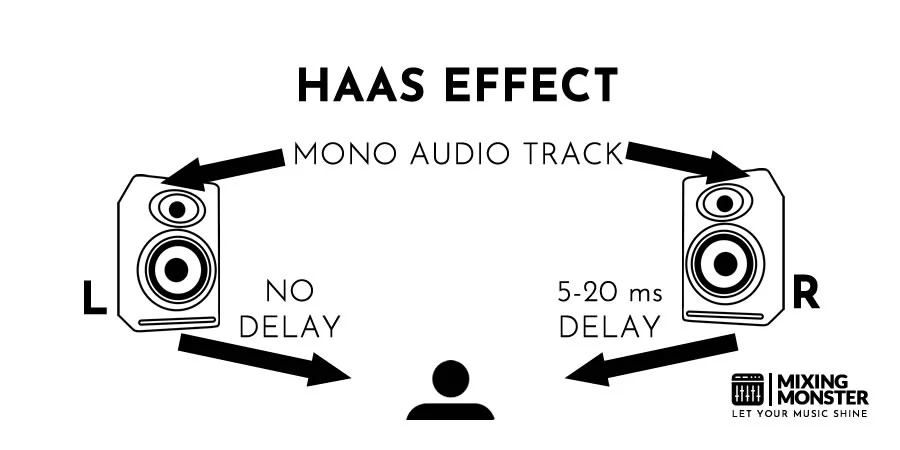
Common techniques include mid-side processing to adjust the relationship between center and side information and subtle Haas effect adjustments. An audio engineer may also employ mid-side EQ to boost high-frequency sparkle in the sides while keeping the low end focused. Using a Haas delay of 5-20 milliseconds can help expand the soundstage, while frequency-specific width adjustments via equalization refine the mid and side channels.
How Stereo Width Affects Perceived Depth And Space
Stereo width directly influences mix depth and how listeners perceive dimensional space within a recording. Wider stereo fields create the illusion that sound sources exist at different distances and positions around the listener.
The human brain interprets timing and level differences between left and right channels as spatial cues. When these differences increase through widening techniques, the soundstage appears to expand beyond the physical speaker positions.
Depth perception emerges from the interaction between direct sounds in the center and ambient information in the sides. Enhancing side content relative to mid content can make elements feel more distant or enveloping, ultimately achieving a three-dimensional sound. This balance is key to a wide stereo image.
Frequency content plays a crucial role in spatial perception. Lower frequencies typically remain narrower to maintain power and focus, while higher frequencies can spread wider to create airiness and dimension without losing clarity.
Stereo Widening Vs Stereo Imaging
Stereo widening and stereo imaging represent related but distinct concepts in audio processing. Stereo imaging encompasses the complete panoramic picture of where elements sit in the stereo field, including their width, depth, and position.
Widening specifically refers to expanding the perceived distance between left and right channels. It functions as one component within the broader discipline of stereo imaging.
Key differences include:
- Stereo imaging addresses overall spatial balance and positioning across the entire frequency spectrum
- Stereo widening focuses specifically on increasing the sense of spaciousness and breadth
- Imaging involves both natural recording techniques and processing decisions
- Widening primarily uses processing effects applied during mixing and mastering
Mastering engineers must balance width enhancement with other imaging concerns, such as mono compatibility and tonal balance. Excessive widening can create an impressive stereo image that collapses poorly when summed to mono.
Why Widening Is Handled Differently In Mixing And Mastering
The approach to stereo widening varies significantly between mixing and mastering stages due to different technical requirements and creative objectives. Mixing allows engineers to work with individual tracks and apply widening to specific elements, such as backing vocals, synthesizers, or reverb returns.
During mixing, engineers can employ panning techniques, double-tracking, and aggressive stereo processing on individual instruments. Techniques like double tracking provide a thick, wide sound that is impossible to replicate perfectly at the mastering stage. This allows for a strong panned center for vocals while pushing other elements to the periphery. This track-level control defines the mix's spatial character.
Mastering operates on the complete stereo mix bus, where changes affect all elements simultaneously. Professional mastering engineers know that mastering stereo widening should enhance rather than reconstruct, requiring subtlety to avoid phase cancellation and frequency imbalances.
The mixing stage establishes the fundamental stereo field through recording techniques and individual processing. Mastering refinement adds polish through minimal adjustments that open up the soundstage without compromising the mixer's original vision or introducing technical problems across different playback systems.

2
Why Stereo Width Matters In Modern Music Production
Stereo width directly affects how listeners perceive space, emotion, and professional quality in recorded music. The balance between centered and wide elements determines whether a stereo mix sounds cramped or expansive across different playback systems.
Listener Perception And Emotional Impact
The human auditory system processes stereo information to create a sense of spatial environment. When properly implemented, stereo width in music production creates an immersive experience that places listeners inside the sonic landscape rather than having them observe from a distance.
A well-balanced stereo mix with appropriate width creates emotional depth by positioning instruments across the sound field. Lead vocals typically sit at the panned center while supporting elements spread left and right. This arrangement mimics how listeners experience live performances. This spatial arrangement allows the brain to separate individual elements more easily.
Research indicates that listeners perceive wider mixes as more professional and engaging. The psychological effect of space contributes to emotional responses, with intimate genres benefiting from narrower imaging and atmospheric genres requiring expansive width to convey their intended mood. Producers often use these tools to create stereo width that complements the musical arrangement.
Stereo Width Across Different Music Genres
Different musical styles demand distinct approaches to stereo width. Electronic dance music typically features extreme width to create club-like atmospheres, with synth pads and effects spreading across the entire stereo field. Hip-hop productions often maintain tighter stereo images, with centered bass and vocals, and use selective widening for atmospheric elements.
Classical and jazz recordings prioritize natural stereo width that reflects actual instrument placement. These genres aim to capture authentic spatial relationships rather than artificially enhanced width. Rock music falls somewhere between, with guitars panned wide while maintaining strong center elements.
Pop music production balances wide stereo elements with mono-compatible low frequencies. Producers craft stereo mixes that sound impressive on headphones while remaining impactful on single-speaker devices. This approach ensures the professional mix translates across all listening scenarios.
Discover Best Audio Gear & Equipment

Competitive Loudness And Spatial Balance
Modern mastering engineers face the challenge of achieving competitive loudness while maintaining stereo width. Excessive compression narrows the stereo field, causing mixes to lose their dimensional quality. Strategic processing preserves width even at high loudness levels.
The relationship between perceived loudness and stereo width affects how tracks compete in playlists. A professional mix with appropriate width appears louder and more present than narrower alternatives at identical peak levels. Engineers balance mono low frequencies with wide high frequencies to maximize both impact and space.
Mid-side processing allows precise control over the relationship between centered and wide elements. This technique enables mastering engineers to enhance width without compromising the structural elements anchored in the center channel.
Translation On Headphones, Speakers, And Streaming Platforms
Headphones reveal stereo width details that speakers may mask, making it essential to verify stereo width decisions across different playback systems. Excessive width can cause phase issues that sound hollow on speakers but impressive on headphones. Professional music production requires testing on both formats.
Streaming platforms apply various processing that can affect stereo width. Some services use lossy compression that alters phase relationships, potentially narrowing or destabilizing the stereo image. Engineers must ensure their stereo mix maintains integrity through these transformations.
Smart speakers and mono Bluetooth devices remain common playback systems. A professional mix maintains its core elements when summed to mono, with stereo width serving as enhancement rather than essential content. Bass frequencies below 120Hz typically stay mono to prevent phase cancellation and ensure translation across all systems.
3
How Stereo Widening Works From A Technical Perspective
Stereo widening uses specific signal-processing methods that manipulate phase relationships, frequency content, and the spatial distribution of audio information between the left and right channels. Understanding these technical mechanisms helps prevent common mistakes, such as phase cancellation and mono compatibility issues.
Mid Side Processing And Stereo Information
Mid-side processing separates a stereo signal into two distinct components: the mid channel and the side channel. The mid channel contains information identical in both left and right channels, typically including centered elements like vocals and bass. The side channel holds the difference between the left and right channels, representing stereo width information.
This separation allows engineers to adjust stereo width by balancing these components. Increasing the side channel level relative to the mid channel creates a wider stereo image. Decreasing it narrows the image or can even collapse it to mono.
The mid-side technique processes these signals separately, offering precise control over stereo width without affecting centered elements. Engineers can apply different EQ, compression, or dynamics processing to each component independently.
M/S processing uses a specific encoding and decoding matrix. The mid signal equals L+R, while the side signal equals L-R. After processing, the decoder converts back to stereo using M+S for the left channel and M-S for the right channel.
Phase Relationships And Mono Compatibility
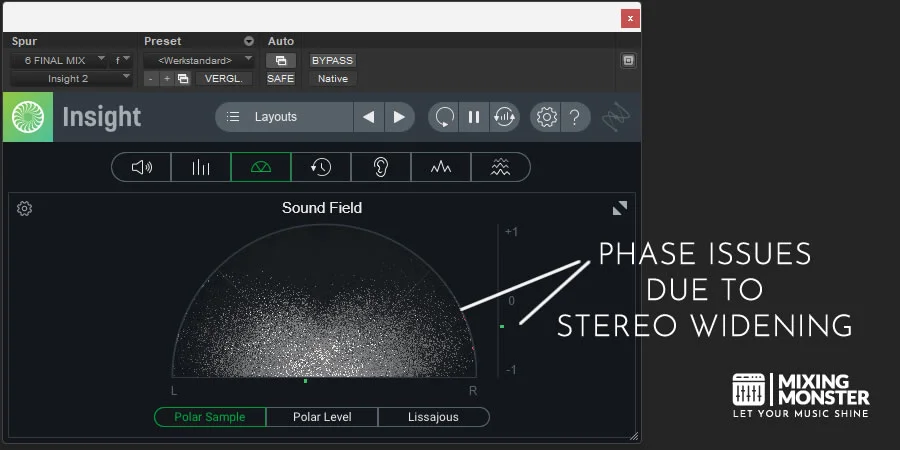
Phase relationships determine how left and right channels interact when combined. When stereo widening introduces delays or phase shifts between channels, these can cause problems during mono playback. If the phase difference reaches 180 degrees, complete cancellation occurs for those frequencies.
A correlation meter measures phase correlation between stereo channels on a scale from -1 to +1. A reading of +1 indicates perfect correlation (mono), 0 shows uncorrelated signals (maximum stereo width), and -1 means completely out of phase. Professional mastering keeps correlation above +0.5 to maintain mono compatibility.
Phase correlation meters provide real-time visual feedback during stereo processing. Engineers monitor these meters to ensure widening techniques don't push correlation into negative values. Most commercial playback systems, including clubs, phones, and radio, still collapse stereo to mono in certain situations.
Testing mono compatibility involves periodically checking the mix in mono. Elements that disappear or sound dramatically different indicate phase issues that must be corrected before finalizing the master.
Your Song Mixed & Mastered By Mixing Monster


Frequency Dependent Width And Psychoacoustics
Low frequencies require careful handling during stereo widening due to physical and perceptual factors. Bass content below 150-200 Hz typically stays centered because human hearing cannot accurately localize these frequencies. Widening low frequencies also creates phase problems that weaken bass response during mono playback.
The human auditory system perceives stereo width primarily through mid and high frequencies. This psychoacoustic principle allows frequency-dependent stereo processing, in which different frequency bands receive different amounts of widening. Engineers often apply more width above 500 Hz while keeping bass frequencies centered.
A multiband imager splits the signal into frequency ranges with independent width controls. This approach maintains tight, focused low end while opening up the midrange and high frequencies. Many mastering engineers apply subtle widening only above 1 kHz for the most natural results. Substantial saturation can also be applied to specific bands to enhance perceived dimension.
Correlation Meters And Visual Stereo Analysis
Correlation meters display the phase relationship between stereo channels as a numerical value or graphical representation. These meters help identify potential mono compatibility issues before they reach final distribution. Engineers use them alongside their ears to make informed decisions about stereo width.
Goniometers provide visual stereo analysis by displaying the relationship between left and right channels on an X-Y plot. A vertical line indicates mono, while a wider pattern shows increased stereo separation. A horizontal figure-eight shape suggests out-of-phase content requiring attention.
Vectorscopes combine correlation and amplitude information into a single display. The width of the pattern indicates stereo spread, while the overall shape reveals balance issues or phase problems. Professional mastering engineers reference these tools throughout the widening process. Harmonic saturation can also increase the perceived intensity of side signals without significantly altering peak levels.
Modern digital audio workstations include built-in metering, though dedicated plugins offer more detailed analysis. Regular monitoring of these visual tools prevents excessive processing that could compromise translation across playback systems.

4
Common Stereo Widening Tools And Approaches
Professional mastering engineers rely on a combination of digital plugins, analog hardware, frequency-based techniques, and dynamic processing to achieve subtle stereo widening without compromising mix integrity. These tools range from dedicated stereo imaging plugins to equalization methods that selectively enhance the stereo field across different frequency ranges.
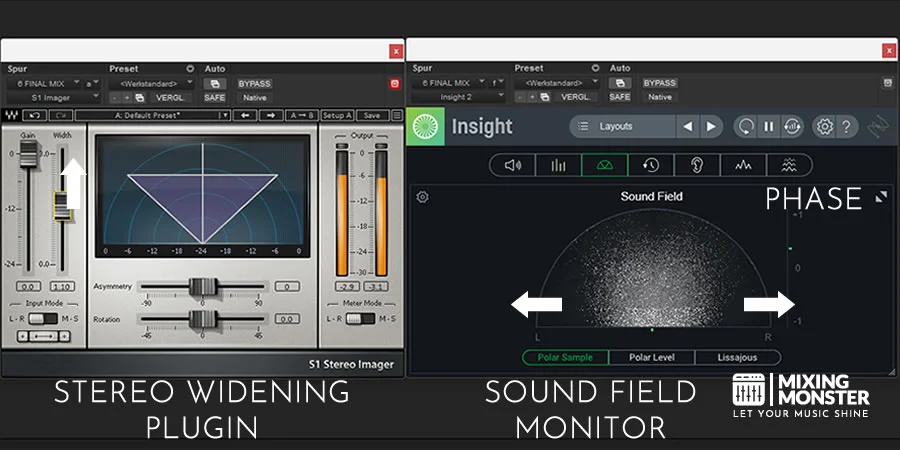
Digital Stereo Widening Plugins And Algorithms
The iZotope Ozone Imager stands as the industry standard for mastering-grade stereo enhancement. As part of the broader Ozone suite, it offers precise control over stereo spread. This plugin allows engineers to visualize and adjust the stereo field with surgical precision.
Waves S1 offers another reliable option, with a simple interface for widening or narrowing the stereo image. The plugin excels at creating subtle stereo widening through its center width and asymmetry controls.
Stereo widening plugins commonly employ algorithms based on the Haas effect, which introduces small delays of 5-20 milliseconds to create the perception of a wider stereo field. Other plugins, such as FabFilter Pro-Q 3, offer mid-side processing that allows frequency-specific stereo manipulation.
Modern stereo imagers often include safety features, such as correlation meters, to prevent phase cancellation. These tools help engineers monitor mono compatibility while applying stereo enhancement. Final limiting is also a critical step, as it can narrow the field if not managed correctly.
Analog Hardware And Stereo Field Enhancement
Hardware stereo enhancers provide a distinct sonic character that digital plugins struggle to replicate. The Klark Teknik 3rd Dimension BBD-320 uses bucket-brigade delay circuits to create natural-sounding width through analog processing.
SSL Fusion offers comprehensive stereo field enhancement alongside other mastering tools in a single unit. Its stereo image circuit manipulates phase relationships to achieve a wider stereo without the artificial quality of some digital processors.
The SPL Stereo Vitalizer Mk2-T combines tube-based processing with psychoacoustic enhancement for a warmer approach to stereo spread. These hardware units often introduce subtle harmonic distortion that contributes to the perception of depth and dimension.
Analog processors excel at creating cohesive stereo enhancement that feels organic rather than processed. The tactile control and zero-latency monitoring make them valuable for engineers who prefer hands-on adjustments during critical mastering decisions.
Related Articles


EQ-Based Width Enhancement Techniques
Mid-side EQ provides one of the most transparent methods for creating stereo width by independently processing the center and side information. A mid-side equalizer allows engineers to boost high frequencies in the side channel while keeping the mid channel focused.
FabFilter Pro-Q 3 excels at mid-side equalization, thanks to its visual feedback and precise surgical control. Engineers can selectively enhance specific frequency ranges in the stereo field without affecting the mono information.
Common techniques include boosting high-mid frequencies (3-8 kHz) in the side channel to create air and openness. Reducing low frequencies below 200 Hz in the side channel helps maintain a solid mono bass foundation while achieving a wide stereo sound in the upper spectrum.
This approach avoids the phase issues associated with delay-based stereo wideners. The frequency-selective nature allows engineers to maintain a proper frequency balance while targeting exactly where stereo enhancement benefits the material most.
Subtle Automation And Dynamic Stereo Control
Dynamic stereo control uses automation to adjust stereo width throughout a track based on musical context. This prevents the static, overly wide quality that comes from applying constant stereo enhancement.
Engineers often automate stereo imagers to narrow during verses and widen during choruses. This creates movement and emphasizes the emotional impact of different sections without compromising the overall mix balance.
Parallel compression combined with stereo effects can add width while maintaining punch. By processing a duplicate signal with stereo delay or hall reverb, then blending it subtly with the dry signal, engineers create depth without washing out the direct sound.
Mid-side compression offers another dynamic approach by controlling the stereo field's behavior in response to the audio content and compressing the mid channel more heavily than the sides, which can create the perception of width by emphasizing the stereo information relative to the center.

5
Benefits And Risks Of Stereo Widening In Mastering
Stereo widening offers mastering engineers powerful tools to enhance spatial characteristics, but it introduces technical challenges that can compromise mix integrity. Proper application requires understanding both the creative possibilities and the phase-related problems that emerge when manipulating the stereo image.
Advantages Of Controlled Stereo Expansion
Stereo widening creates spaciousness and depth, making productions feel more immersive and professional. When applied subtly during mastering, it helps choruses feel bigger and more impactful compared to verses, creating dynamic contrast throughout a track.
Controlled expansion allows backing vocals and ambient elements to spread across the stereo field without competing with centered lead vocals. Synths and pads benefit particularly well from width enhancement, surrounding the listener while maintaining a solid phantom center for essential mono elements.
The key advantage lies in the subtlety of application. Small incremental changes—typically no more than 10-15% enhancement—can open up a mix during structural transitions without introducing artifacts. This approach preserves mono compatibility while still delivering the spatial improvements that modern productions demand.
Over-Widening And Its Sonic Consequences
Excessive stereo widening weakens a mix's cohesion and creates an artificial, detached sound. When mastering engineers push width parameters too far, tracks lose power and focus, particularly affecting elements that depend on strong center imaging, such as kick drums and lead vocals.
Over-widening introduces phase issues that become immediately apparent in mono playback situations. Since many listeners consume audio through smartphone speakers or mono Bluetooth devices, aggressive widening can result in a thin, hollow sound that lacks the impact of the original mix.
Bass frequencies suffer most dramatically from excessive width processing. Low-end content should remain tight and central to maintain punch and definition. Widening below 200Hz typically causes the mix to lose its foundation, resulting in a weak, unfocused bottom end that fails to translate across playback systems.
Phase Cancellation And Loss Of Focus
Phase cancellation occurs when stereo widening techniques manipulate the phase relationships between left and right channels. Comb filtering and phase interference occur when these channels sum to mono, causing certain frequencies to partially or completely cancel.
Delay-based widening methods create particularly severe phase problems. The Haas effect and similar techniques introduce timing differences that sound impressive in stereo but collapse poorly in mono. Fast-attack transients, such as snare hits and percussion, can introduce subtle artifacts even with phase-coherent algorithms.
Maintaining low-end mono compatibility prevents phase cancellation in the most critical frequency range. Most professional mastering engineers keep content below 150-200Hz entirely centered to preserve punch and ensure the mix translates properly to club systems, radio broadcasts, and streaming platforms that employ mono summing.
When Narrowing The Stereo Image Is The Better Choice
Some productions benefit from narrowing the stereo image rather than widening it during mastering. Dense mixes with excessive stereo information often sound more cohesive and powerful when the engineer reduces width, particularly in busy frequency ranges where elements compete for space.
Tracks intended for mono playback environments—including podcasts, voice-over work, and certain broadcast applications—require narrower imaging to maintain clarity. Building width during mixing on individual elements proves more effective than attempting to fix width problems during mastering.
Genre considerations also influence width decisions. Hip-hop and trap productions often benefit from tighter imaging that emphasizes center impact over spatial expansion. When the phantom center lacks definition or vocals sound diffuse, narrowing the stereo image restores focus and improves intelligibility across all playback systems.

6
Stereo Widening Best Practices At The Mastering Stage
Applying stereo widening during mastering requires careful decision-making based on the mix's existing stereo field, genre expectations, and monitoring conditions. Engineers must balance the desire for width against potential technical problems while maintaining mono compatibility.
Knowing When Stereo Widening Is Necessary
The mastering engineer must first evaluate whether the mix actually needs additional width. A mix that already has a strong stereo image may suffer from over-processing if unnecessary widening is applied.
Mixing in mono helps reveal whether the core elements maintain their presence and balance when the stereo field collapses. If critical elements disappear or change significantly in mono, the mix may already have too much width by the time mastering begins.
Signs that stereo widening might be necessary include a narrow soundstage where instruments cluster in the center, or a mix that lacks dimension compared to commercial releases. However, if the mix already sounds balanced and spacious, additional widening can create phase issues and an unnatural presentation. The mastering stage should enhance what already exists rather than fundamentally transform the mix.
Genre-Specific Stereo Width Expectations
Different musical genres have established stereo width conventions that listeners expect. Electronic music and modern pop productions typically feature pronounced stereo width with heavily processed spatial elements.
Classical and jazz recordings require a more natural stereo image that reflects actual performance spaces. Applying aggressive widening to these genres creates an artificial sound that contradicts the acoustic authenticity listeners expect.
Rock and metal productions usually maintain strongly centered elements like vocals, kick drums, and bass while allowing guitars and cymbals to occupy the sides. Singer-songwriters and acoustic material benefit from a moderate width that preserves intimacy. Hip-hop productions vary widely, with some tracks featuring minimal width for club playback while others use extensive stereo effects on certain elements.
Monitoring Environment And Reference Tracks
The mastering engineer's monitoring environment significantly impacts stereo widening decisions. Accurate speakers positioned correctly in a treated room reveal how widening affects the stereo field across different frequencies.
Engineers should use reference tracks from the same genre to establish appropriate width targets. Comparing the track being mastered to commercial releases helps determine whether additional widening is needed or whether the existing stereo image already meets industry standards.
Testing on multiple playback systems, including headphones, car speakers, and consumer earbuds, ensures the widening translates properly. What sounds impressive on studio monitors may collapse poorly on smaller systems or create phase problems in certain listening environments.
Why Less Is More In Mastering Widening Decisions
Subtle mastering stereo widening preserves the mix's integrity while avoiding technical problems. Excessive widening creates phase cancellation, weakening the low end and causing certain frequencies to disappear when played in mono.
Applying the width incrementally allows the engineer to find the point at which the enhancement becomes noticeable without crossing into unnatural territory. Small adjustments of 5-10% often provide sufficient improvement without risking the structural balance of the mix.
Low frequencies below 200 Hz should rarely receive widening treatment as this creates instability and reduces power on club systems and portable speakers. Mid-range frequencies containing vocals and lead instruments need careful handling to maintain their central presence. Only high frequencies and ambient elements typically benefit from more pronounced width expansion during mastering.

7
Key Takeaways For Stereo Widening In Mastering
Stereo widening creates spaciousness and depth in audio through various processing techniques. Engineers must apply these methods carefully to avoid phase issues and unnatural artifacts.
Essential Principles:
- Use moderation - Subtle adjustments enhance natural stereo fields better than extreme processing.
- Check mono compatibility - Excessive widening introduces phase problems that cause clarity loss in mono playback.
- Consider genre context - Classical and jazz benefit from natural imaging, while electronic music accepts wider stereo fields.
- Test across systems - Verify stereo image consistency on different speakers and listening environments
Primary Techniques:
- Mid-Side Processing - Separates mid and side components for independent level adjustments
- Haas Effect - Applies 5-20 millisecond delays between channels to create a width illusion
- EQ Adjustments - Balances frequencies differently between left and right channels
- Spatial Imaging - Uses dedicated plugins to adjust stereo width across frequency ranges
The Haas effect creates a stereo illusion based on how the brain perceives the timing of sound arrival. This psychoacoustic phenomenon works only when sounds remain similar between channels.
Professional mastering engineers recommend addressing stereo width during the recording and mixing stages rather than relying on mastering fixes. Mastering should enhance existing width, not create artificial stereo fields.
Engineers should follow the rule "when in doubt, leave it out" when applying stereo widening. Overprocessing damages the mix integrity more than conservative approaches.
Happy stereo widening!

Frequently Asked Questions
1
What are the best practices for applying stereo widening during the mastering process?
Engineers should start by analyzing the mix in stereo, mono, and mid-side modes to understand the existing stereo balance before making any changes. This comprehensive evaluation reveals which frequency ranges contain side information and whether the stereo field needs adjustment.
Processing the stereo width should focus on enhancing the initial musical idea rather than creating an entirely new sense of depth. High-frequency changes are generally more forgiving than mid-frequency alterations, as the mid-range contains competing elements that are highly noticeable.
Low-frequency content requires careful consideration during stereo processing. Widening bass frequencies can create an uneven distribution of energy between left and right channels, which is why bass elements typically remain centered.
Engineers must always verify mono compatibility after applying any stereo widening. A mix that sounds impressive in stereo but falls apart in mono will fail in many real-world playback scenarios.
2
What impact does a stereo widener have on a mix, and how does it differ from panning?
A stereo widener manipulates the side signal to create the perception of increased width across the stereo field. This process affects existing spatial information rather than repositioning individual elements.
Panning places specific sounds at different positions between the left and right speakers. It creates separation by assigning elements to discrete locations in the stereo field during mixing.
Stereo widening tools enhance the difference between left and right channels, making the side image more prominent. This can include techniques such as the Haas effect and mid-side processing that operate on the overall stereo information.
The key difference lies in application: panning is a placement tool used during mixing, while stereo widening is an enhancement technique often applied during mastering. Widening affects the spatial character of already-panned elements rather than changing their fundamental positioning.
3
How can one achieve a natural-sounding stereo image without overusing wideners?
Engineers should focus on enhancing what already exists in the mix rather than artificially widening it. Analyzing the side signal reveals natural stereo information from reverbs, delays, and stereo-recorded instruments that can be subtly emphasized.
Applying stereo widening selectively to specific frequency ranges produces more natural results than broadband processing. High frequencies often respond well to modest widening without creating obvious artifacts.
Increasing stereo width often changes the balance between center and side elements. Reverb information and other panned signals become more prominent, which can shift the mix balance in unpleasing ways if pushed too far.
Engineers should frequently run A/B comparisons and check how changes affect the music's perceived character. If the processing becomes noticeable as an effect rather than an enhancement, it has gone too far.
4
When mastering, how much stereo widening is too much, and what are the signs of over-widening?
The mix sounds thin or weak when checked in mono, indicating that phase relationships have been compromised. This is particularly problematic for playback on club systems and single-speaker devices.
Elements that should remain centered, particularly vocals and bass, appear to lose focus or coherence. The center image becomes hollow or lacks the original mix's solidity.
Over-widening creates phase problems that weaken the track's impact on various playback systems. The sides become distractingly prominent while the center feels empty or disconnected.
When individual instruments or elements become difficult to locate in the stereo field, the widening has exceeded useful limits. Natural spatial cues should remain intact even after processing.
5
In what scenarios is it appropriate to use stereo imaging tools for enhancing mix width?
Stereo imaging tools are valuable when a mix has adequate stereo information that needs subtle enhancement to meet modern production standards. Tracks with natural stereo sources, such as acoustic instruments, room ambiance, or stereo synthesizers, often benefit from careful widening.
Engineers may apply stereo imaging when high-frequency elements need more presence without increasing overall volume. This approach can create space and clarity in dense arrangements where frequency masking occurs.
Mixes that sound narrow or boxed-in compared to reference tracks in the same genre may benefit from targeted stereo enhancement. However, the mixing engineer should have already established a strong stereo foundation.
Stereo imaging works well for adding depth to reverbs and delays that already exist in the mix. These spatial effects naturally occupy the sides and respond well to modest enhancement without creating balance issues.
6
How can stereo width be controlled or reduced when a mix is excessively wide?
Mid-side processing allows engineers to reduce the side signal relative to the mid signal, bringing elements back toward the center. This technique is especially useful for controlling specific frequency ranges that contain excessive stereo information.
Low-frequency content can be made more mono by reducing or eliminating side information below a certain frequency threshold. This "tightens" the low end without affecting the stereo character of higher frequencies.
Engineers should evaluate whether substantial low-end information is present in the side signal from elements such as guitars, vocals, or synths. Pulling these elements toward the center by a certain degree improves mono compatibility and focus.
Dedicated stereo-imaging plugins offer width controls that can narrow the stereo field when needed. These tools provide precise control over the degree of difference between the left and right channels.