





If you've ever wondered why some tracks sound perfectly balanced across platforms while others seem too quiet or distorted, the answer lies in LUFS and how they control modern audio delivery standards. These loudness units relative to full scale provide a consistent way to monitor your projects. These measurements are based on the ITU-R BS.1770 standard, which defines how to evaluate audio levels relative to digital full scale.
LUFS stands for Loudness Units relative to Full Scale, a standardized measurement that quantifies perceived audio loudness rather than just technical signal levels. Unlike traditional peak meters that measure electrical signal strength, LUFS reflect how humans actually perceive sound by integrating both level and frequency sensitivity into a single value. This makes LUFS the global standard for music streaming platforms, podcasts, broadcast television, and film production.
Every major platform from Spotify to YouTube uses LUFS to ensure consistent playback volumes, replacing the outdated "loudness wars" approach that compromised audio quality.
Understanding audio loudness through LUFS measurements transforms how producers, engineers, and content creators approach their work. This guide breaks down the technical foundations of loudness measurement, reveals platform-specific targets that keep your content compliant, and provides practical techniques for measuring and adjusting LUFS in your projects.
Whether you're mastering tracks for streaming services, producing podcasts, or delivering broadcast content, knowing how to work with LUFS ensures your audio translates properly across every listening environment without unwanted normalization or distortion.
Key Takeaways / TL;DR
- LUFS measures perceived loudness based on human hearing rather than just technical signal levels
- Different platforms require specific LUFS targets ranging from -14 LUFS for streaming to -23 LUFS for broadcast.
- Professional loudness metering tools help achieve target levels while maintaining dynamic range and preventing distortion.

1
What Are LUFS In Audio Production
LUFS is a standardized measurement system that quantifies perceived loudness in digital audio by accounting for how the human ear perceives different frequencies. This measurement differs fundamentally from peak-based meters by using frequency weighting and time-based analysis to reflect actual listening experience.
The Technical Definition Of LUFS
LUFS stands for Loudness Units Full Scale, a measurement that quantifies audio loudness relative to the maximum level achievable in fixed-point digital audio systems. The "full scale" portion mirrors the dBFS concept, where 0 represents the digital full-scale ceiling. You might also encounter the term LKFS, which stands for Loudness, K-weighted, relative to Full Scale; for all practical purposes in music production, LKFS and LUFS are identical.
A loudness unit functions similarly to a decibel but incorporates perceptual weighting based on human hearing characteristics. When the audio level increases by 3 dB, the LUFS reading also increases by 3 LU. However, applying equalization without level changes can alter LUFS values because the measurement accounts for frequency content.
The calculation process begins with a K-weighting filter that applies a 4 dB high-shelf boost above 2 kHz and a 12 dB/octave high-pass filter at 100 Hz. This filtering simulates human ear sensitivity, which perceives higher frequencies as louder and lower frequencies as quieter at equivalent sound pressure levels.
How LUFS Differs From dBFS and RMS Measurements
dBFS measures instantaneous sample values in digital audio without considering frequency content or temporal characteristics. A bass-heavy track and a treble-focused track at identical dBFS levels sound drastically different in perceived loudness.
RMS readings calculate the average power of an audio signal over time, providing a more consistent measurement than peak meters. However, RMS lacks standardized integration times and frequency weighting so that different meters can display different values for the same audio.
LUFS addresses these limitations through three key improvements:
- The K-weighting filter adjusts measurement sensitivity across the frequency spectrum
- Standardized integration windows ensure consistent readings across all compliant meters
- Multiple timeframes capture momentary (400ms), short-term (3 seconds), and integrated (entire program) loudness
The difference between LUFS and RMS becomes evident during equalization—boosting mid-range frequencies significantly affects LUFS values while RMS changes minimally.
The History And Development Of LUFS Standards
The International Telecommunication Union developed the LUFS standard through recommendation BS.1770, first published to address inconsistent loudness levels across broadcast content. Viewers experienced jarring volume jumps between programs and commercials, prompting regulatory intervention.
The European Broadcasting Union adopted these specifications in technical documents 3341 and 3342, establishing concrete implementation guidelines based on EBU R128. This framework revolutionized how audio levels are managed in international broadcasting.
These standards evolved through multiple revisions, with the ITU-R BS.1770-4 as the current version referenced by audio professionals today. This version introduced specific gating methods to prevent quiet passages from artificially lowering the integrated loudness score.
Streaming platforms subsequently adapted broadcast LUFS standards for music delivery. Services need consistent playback levels across diverse catalogs without requiring listeners to adjust volume controls constantly.
Why LUFS Matters For Modern Audio Professionals
Streaming platforms apply loudness normalization that adjusts playback levels to target values around -14 LUFS integrated. Spotify, Apple Music, Tidal, Amazon Music, and YouTube all implement LUFS-based normalization, though specific targets vary slightly between services. Understanding these variations helps you prepare masters that sound consistent everywhere.
Delivery specifications for television and film require audio to meet precise LUFS requirements. Netflix, Amazon Prime, and other streaming video platforms mandate specific integrated loudness, true peak, and loudness range values that content must satisfy before acceptance.
Understanding LUFS enables mixing and mastering engineers to predict how their work will translate across playback environments. A master that sounds powerful in the studio might sound compressed and lifeless after platform normalization reduces its level by 6 dB.
Professional workflows now incorporate LUFS metering throughout production stages rather than solely during final mastering. This approach helps engineers make informed decisions about compression, limiting, and dynamic range that align with distribution requirements.

2
Understanding Loudness Units And Full Scale Measurements
LUFS measurements combine loudness units with full-scale referencing to create a standardized method for measuring perceived loudness in digital audio. The system applies frequency-weighting filters that mirror human hearing characteristics, resulting in measurements that better align with how listeners actually experience audio content.
Breaking Down The LUFS Acronym
LUFS stands for Loudness Units Full Scale, which represents a measurement system that combines two critical concepts in digital audio metering. The "loudness units" portion refers to the unit of measurement itself, while "full scale" indicates that these measurements are referenced to the maximum level allowable in digital audio systems.
Loudness units function similarly to decibels, with one fundamental difference. When audio is increased by 3 dB, its LUFS reading also increases by 3 LU. However, applying equalization without changing the overall level can still alter the LUFS value based on the frequency content.
The full-scale reference works identically to dBFS measurements, where 0 represents the digital ceiling. This means LUFS measures loudness relative to the maximum digital level rather than using an arbitrary reference point.
Integrated LUFS Versus Short-Term And Momentary LUFS
Integrated LUFS calculates the average loudness across an entire audio program, whether that's a song, podcast episode, or film. This measurement uses a 400ms window for momentary readings and employs two gates: one at -70 LUFS and a floating gate 10 LU below the current integrated level.
Short-term LUFS, also called short-term loudness, provides a moving average of the last 3 seconds of audio, smoothing out rapid level fluctuations. This measurement moves more slowly than momentary readings and typically displays slightly lower values due to its averaging algorithm.
Momentary LUFS uses a 400ms integration time and is the most responsive measurement type. Each measurement window overlaps the previous one by 75%, ensuring smooth, consistent readings across all LUFS meters. Engineers also monitor peak loudness to ensure the signal never exceeds the technical limits of the digital system.
LUFS Measurement Types:
|
Measurement Type |
Integration Time |
Primary Use Case |
|
Momentary |
400ms |
Real-time monitoring during mixing |
|
Short-term |
3 seconds |
Dynamic level tracking |
|
Integrated |
Full program |
Final delivery specifications |
Discover Best Audio Gear & Equipment

The Relationship Between Loudness Units And Human Perception
LUFS measurements attempt to quantify perceived loudness by accounting for how the human auditory system processes different frequencies. The system recognizes that two audio signals with identical peak levels can sound dramatically different in perceived loudness depending on their frequency content.
The measurement process applies weighting curves that reduce the contribution of very low frequencies and slightly emphasize mid- to high-frequency components. This addresses historical problems with RMS and VU meters, which were oversensitive to bass and insufficiently responsive to treble frequencies.
While LUFS aims to measure how humans actually perceive loudness, two tracks measuring at -14 LUFS integrated may still exhibit small differences in perceived volume. Arrangement choices, spectral balance, and dynamic processing all influence how loud a mix feels beyond the raw LUFS number.
K-Weighting And Frequency Response In LUFS Calculations
K-weighting forms the foundation of all LUFS calculations by applying specific filters to incoming audio before measurement. The system implements a 4 dB high-shelf filter above approximately 2 kHz, reflecting the increased sensitivity of human hearing to higher frequencies.
A 12 dB/octave high-pass filter at 100 Hz reduces the influence of sub-bass frequencies on the measurement. This dual-filter approach simulates how the ear-brain system processes tonal balance when determining loudness, creating measurements that better match subjective listening experiences.
After K-weighting filters are applied, the system calculates RMS levels from the filtered audio. These K-weighted RMS values then feed into the momentary, short-term, and integrated loudness calculations that form the complete LUFS measurement suite.
3
LUFS Standards Across Different Platforms And Media
Different platforms enforce specific loudness targets to ensure consistent playback experiences across their services. Streaming platforms typically normalize audio to -14 LUFS, while broadcast television requires stricter -23 LUFS compliance, and podcasts generally target -16 LUFS.
Streaming Service LUFS Requirements (Spotify, Apple Music, YouTube)
Streaming platforms use LUFS normalization to maintain consistent volume levels across different tracks and albums. Spotify normalizes audio to approximately -14 LUFS in Normal mode, with alternative settings for Loud (-11 LUFS) and Quiet (-19 LUFS).
Apple Music targets -16 LUFS for stereo content with a True Peak limit of -1 dBTP. For spatial audio content in Dolby Atmos format, the platform requires -18 LUFS.
YouTube also normalizes content to around -14 LUFS, though implementation varies and isn't always consistent across different video types. Amazon Music adheres to the -14 LUFS standard, with a slightly stricter True Peak limit of -2 dBTP.
Key Streaming Platform Targets:
|
Platform |
Target LUFS |
True Peak Limit |
|
Spotify |
-14 LUFS |
-1 dBTP |
|
Apple Music |
-16 LUFS (Stereo) |
-1 dBTP |
|
YouTube |
-14 LUFS |
-1 dBTP |
|
Tidal |
-14 LUFS |
-1 dBTP |
|
Amazon Music |
-14 LUFS |
-2 dBTP |
When content exceeds these targets, streaming services automatically reduce playback volume. This means overly loud masters don't provide any competitive advantage and may actually degrade the listening experience.

Broadcast Television And Radio LUFS Specifications
Broadcast standards require -23 LUFS compliance in most European and UK markets, with a tolerance of ±1 LU. These specifications follow the EBU R128 standard established to prevent jarring volume changes between programs and commercials.
North American broadcasters follow ATSC A/85 standards, which also specify -24 LUFS for television content. True Peak limits typically remain at -1 dBTP to prevent inter-sample clipping during format conversion.
Radio broadcasts often target similar audiences but may vary depending on the station's format and regional regulations. Commercial radio sometimes permits slightly louder levels compared to public broadcasting.
Broadcast content must pass quality control checks before transmission—failure to meet these loudness specifications results in rejected deliverables and costly remixing.
Your Song Mixed & Mastered By Mixing Monster


Film And Cinema Audio Loudness Standards
Cinema audio follows different loudness standards compared to streaming and broadcast. Theatrical mixes typically target dialogue levels around -27 LUFS for feature films, allowing for greater dynamic range in action sequences and quiet moments.
Film content intended for streaming distribution requires separate mixes to meet platform specifications. A theatrical mix at -27 LUFS would sound too quiet on streaming services without proper adaptation.
Home video releases on Blu-ray and DVD typically target -24 to -27 LUFS depending on the distributor's preferences. These formats preserve the original theatrical presentation's wider dynamic range while remaining appropriate for home playback systems.
Podcast And Audiobook LUFS Recommendations
Podcast audio typically targets -16 LUFS ±1 LU, which is the accepted industry standard across major podcast platforms. This level provides comfortable listening on mobile devices and in various environments without requiring constant volume adjustments.
Audiobook production generally aims for a similar target range of -16 to -18 LUFS. Consistent loudness throughout long-form spoken content prevents listener fatigue during extended listening sessions.
Many podcast hosting platforms recommend maintaining True Peak levels below -1 dBTP to avoid distortion during encoding and playback. Loudness Range (LRA) values between 5 and 10 LU help ensure dialogue remains intelligible while preserving natural vocal dynamics.
Spoken Word Content Guidelines:
- Podcasts: -16 LUFS ±1 LU
- Audiobooks: -16 to -18 LUFS
- True Peak: -1 dBTP maximum
- Loudness Range: 5-10 LU

4
How To Measure LUFS In Your Audio Projects
Measuring LUFS requires specialized metering tools that analyze audio through K-weighting filters and calculate integrated, short-term, and momentary loudness values. Proper setup and interpretation of these meters ensures accurate loudness measurements throughout mixing and mastering workflows.
Essential LUFS Metering Tools And Plugins
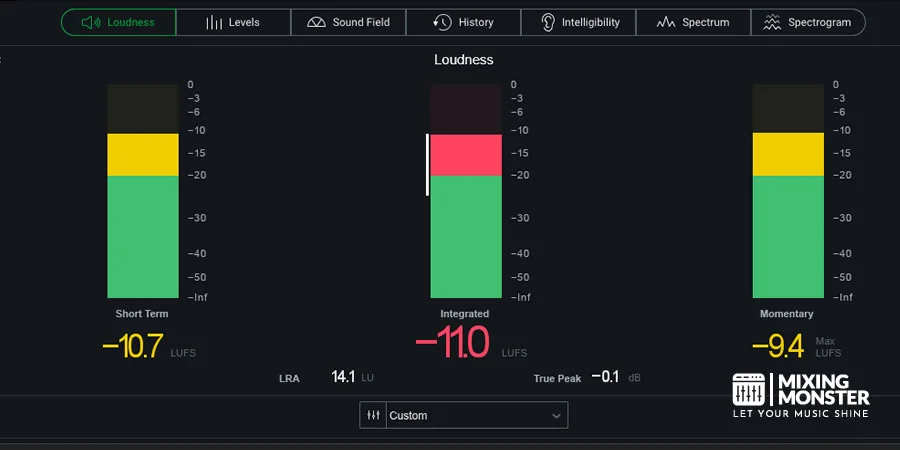
Professional LUFS metering requires dedicated plugins that comply with ITU BS.1770-4 standards. Izotope Insight provides comprehensive loudness analysis with all five key metrics, including momentary, short-term, integrated loudness, LRA, and true peak measurements.
Many professionals prefer Izotope Insight for its detailed visual feedback and history logging features. Waves WLM Plus offers broadcast-standard metering for film and television projects.
Free options include Youlean Loudness Meter, which delivers accurate integrated LUFS readings and supports multiple platform presets. Klangfreund LUFS Meter works across major DAWs and provides real-time loudness monitoring. TC Electronic Clarity M Stereo combines LUFS metering with spectral analysis tools.
Hardware solutions like SSL The Bus+ Compressor and Bettermaker Mastering Limiter include built-in LUFS meters for integration with analog workflows. These units display real-time loudness measurements as audio is processed. Many modern audio interfaces now incorporate basic loudness metering in their control software.
The choice between plugins and hardware depends on workflow requirements and budget constraints. Most producers rely on plugin-based solutions for flexibility and visual feedback during mixing and mastering sessions.
Setting Up LUFS Meters In Your DAW
Insert the LUFS meter plugin on the master fader as the final processor in the signal chain. This placement ensures accurate measurement of the final output level after all processing, limiting, and effects. Position the meter after any master bus compressors, EQs, and limiters to capture the true output loudness.
Configure the meter's integration time settings based on the project type. Music production typically uses continuous integration mode, which measures from the start of playback to its end. Broadcast and film projects may require gated integration modes that exclude silent passages below specific thresholds.
Set the meter's target reference level according to the delivery platform. Streaming services like Spotify use -14 LUFS for integrated audio, while YouTube uses -14 LUFS, and broadcast television requires -24 LUFS for dialogue. Many meters include platform-specific presets that automatically configure these targets.
Enable true peak monitoring and set the ceiling to -1 dBTP or lower to prevent intersample peaks during codec conversion. Understanding how to check loudness in your DAW requires paying attention to both integrated and true-peak readings throughout the session.
Related Articles
Reading And Interpreting LUFS Measurements
Integrated loudness displays the average loudness across an entire program when played from start to finish. This measurement uses gates at -70 LUFS and 10 LU below the current integrated level to exclude silence and extremely quiet passages. A music track with an integrated -14 LUFS will play at the same perceived volume as other -14 LUFS tracks on normalized streaming platforms.
Short-term loudness shows a three-second moving average of momentary values. This reading smooths out rapid level changes and provides insight into how loud sections feel to listeners. Producers monitor short-term levels during mixing to maintain consistency between verses and choruses.
Momentary loudness updates every 400 milliseconds with 75% overlap between measurements. This faster reading helps identify brief peaks and transients that affect the overall dynamic character. Engineers reference momentary levels when setting attack and release times on compressors and limiters.
LRA (Loudness Range) indicates the dynamic spread where approximately 50% of the loudness measurements occur. Low LRA values below 3 LU suggest heavy compression or limiting, while high values above 15 LU indicate substantial dynamic variation. Managing LUFS in audio projects requires balancing integrated targets with appropriate dynamic range.
Common Mistakes When Measuring LUFS
Playing only the loudest sections repeatedly skews integrated loudness measurements higher than the actual program average. The meter calculates integrated values based on what it receives during playback, so loop-monitoring choruses produce inflated readings. Engineers must play the entire track from start to finish for accurate integrated measurements.
Measuring before final limiting stages generates misleading loudness data that doesn't reflect the delivered master. Some producers check LUFS on rough mixes without accounting for the 3-6 dB of level increase that limiting adds. This leads to targets being missed when the limiter pushes the integrated loudness well above the intended delivery specification.
Ignoring true peak readings while focusing solely on LUFS integrated causes clipping during lossy codec conversion. A track measuring -14 LUFS with peaks at 0 dBTP will distort when encoded to MP3 or AAC format. Maintaining -1 to -2 dBTP headroom prevents intersample peaks in consumer playback devices.
Comparing LUFS measurements across different meter plugins without verifying compliance with compliance standards creates inconsistencies. Non-compliant meters may use incorrect K-weighting filters or integration times that produce inaccurate readings. Using meters that comply with ITU BS.1770-4 loudness measurement standards ensures reliable, consistent results across projects.

5
Mastering Audio To Target LUFS Levels
Achieving specific LUFS targets during mastering requires careful gain staging, strategic use of dynamics processing, and awareness of how loudness normalization affects playback across platforms. The goal is to hit platform requirements without sacrificing the musical qualities that make a track engaging.
Gain Staging For Optimal LUFS Performance
Proper gain staging establishes the foundation for meeting LUFS targets before applying any processing. Engineers should check the integrated LUFS reading of their initial mix and calculate the adjustment needed to reach the target level.
Most streaming platforms normalize to around -14 LUFS for integrated loudness. If a mix measures -18 LUFS integrated, it needs approximately 4 dB of gain to reach the target. Rather than applying all adjustments through limiting, engineers can use utility gain plugins at various stages of the mastering chain.
Monitoring short-term and momentary LUFS readings alongside integrated measurements helps identify sections that may cause the overall loudness to fall short of the target. Peaking no higher than -1 dBTP prevents clipping while leaving headroom for encoding processes.
Starting with conservative gain adjustments and building up gradually produces cleaner results than trying to rescue an over-processed master. Each processing stage should contribute to the final loudness goal without any single plugin doing excessive work.
Using Limiters And Compressors To Achieve Target LUFS
Limiters serve as the primary tool for increasing loudness to meet LUFS targets while preventing digital clipping. A transparent limiter with lookahead functionality catches peaks before they exceed the true peak ceiling, allowing the overall level to rise without distortion.
Applying compression before limiting helps control dynamic range and reduces the amount of limiting required. Multiband compression targets specific frequency ranges that may cause inconsistent loudness readings, particularly in bass-heavy or bright material.
The key is applying processing in stages rather than relying on a single limiter to achieve all gain reduction. Using 2-3 dB of compression followed by moderate limiting produces more musical results than 6+ dB of limiting alone. Setting limiter attack and release times to match the program material prevents pumping artifacts.
Engineers should compare their processed audio against the unprocessed version to ensure the dynamics processing enhances rather than degrades the sound. If the limited version sounds noticeably worse, backing off the processing and accepting a slightly lower LUFS reading often yields better results.
Maintaining Dynamic Range While Meeting LUFS Requirements
Dynamic range preservation remains crucial even when targeting specific LUFS levels. Platforms recommend mastering around -14 LUFS, but this represents an average measurement across the entire track, not a constant level.
Music with greater dynamic variation naturally sits slightly below -14 LUFS integrated while containing louder sections that peak higher. The loudest parts hitting -10 LUFS short-term, while quieter sections drop to -18 LUFS, create an engaging contrast that holds listener attention.
Loudness Range (LRA) measurements quantify dynamic variation, with values between 6 and 10 LU considered appropriate for most contemporary music. Excessive compression that reduces LRA below 4 LU typically sounds fatiguing and lifeless regardless of the integrated LUFS reading.
Mastering engineers should prioritize preserving transients and musical dynamics over hitting exact numerical targets. Slight variations of 1-2 LUFS below platform targets maintain musicality while still playing back at comparable levels after normalization.
The Loudness War And Why LUFS Ended It
The loudness war refers to the decades-long trend of mastering music progressively louder by reducing dynamic range through aggressive limiting and compression. Artists and labels believed louder tracks would stand out on the radio and grab listener attention, leading to increasingly squashed masters.
In the pre-streaming era, mastering often pushed tracks to -6 LUFS integrated or louder, sacrificing punch and clarity for a perceived volume advantage. This arms race made listening sessions fatiguing and diminished the impact of genuinely dynamic productions.
Streaming platforms that implemented loudness normalization effectively ended the loudness war by automatically adjusting playback levels. Tracks mastered louder than platform targets get turned down, while quieter masters get boosted, eliminating any competitive advantage from extreme limiting.
The shift to LUFS-based normalization rewards masters that balance loudness with dynamic range. Over-limited tracks that measure -8 LUFS integrated playback at the same volume as properly mastered -14 LUFS tracks but sound worse due to excessive processing. This incentivizes better mastering practices focused on musicality rather than raw numbers.

6
LUFS In Music Production And Mixing
During mixing, engineers use LUFS measurements to establish proper gain staging and ensure sufficient headroom for mastering. Target LUFS values vary by genre and streaming platform requirements, with typical mixing ranges falling between -20 and -18 LUFS for short-term readings.
Setting LUFS Targets During The Mixing Stage
The initial approach to LUFS during mixing differs significantly from mastering targets. Mixers typically aim for short-term LUFS readings of -20 to -18 on the master bus. This range provides adequate headroom for processing during mastering while maintaining a workable level of balance.
Starting with key elements like vocals or lead instruments around these target ranges helps establish a foundation. Engineers should monitor momentary LUFS values for individual mix elements to understand their contribution to the overall loudness. Bass elements and drums typically read higher in momentary LUFS due to their energy content.
The integrated LUFS reading during mixing usually falls between -24 and -20 LUFS. This measurement matters less than maintaining proper relationships between elements and preserving dynamics. Engineers should avoid pushing levels too high at this stage, as it limits mastering options and can introduce unwanted compression artifacts.
Balancing Loudness And Clarity In Your Mix
Achieving both loudness and clarity requires careful attention to frequency balance and dynamic range. The K-weighting filter used in LUFS calculations emphasizes mid- and high frequencies, so treble-heavy mixes may read louder than bass-heavy mixes at the same peak level.
Excessive low-frequency content can consume headroom without contributing proportionally to perceived loudness. High-pass filtering non-bass elements removes unnecessary low-end buildup. This technique creates space in the mix and allows for higher LUFS readings without clipping.
LRA (Loudness Range) measurements between 3 and 15 LU typically indicate a well-balanced mix. Values below 3 LU suggest over-compression, while readings above 15 LU may signal inconsistent levels that challenge mastering engineers. Monitoring LRA throughout the mixing process helps identify sections requiring level automation or dynamic processing adjustments.
Genre-Specific LUFS Considerations
Different musical genres exhibit distinct LUFS characteristics that reflect their typical dynamic requirements.
EDM and pop productions often feature lower LRA values (3-6 LU) with integrated LUFS around -6 to -8 during mastering. These genres prioritize consistent energy and compete for attention in playlists.
Rock and indie music typically offers a greater dynamic range, with LRA values between 6 and 10 LU and integrated LUFS around -8 to -10. Classical and jazz recordings preserve the widest dynamic range, often exceeding 15 LU in LRA with integrated LUFS between -14 and -18.
Hip-hop and R&B productions balance dynamic vocals with consistent instrumental sections, resulting in LRA values around 5-9 LU.
Understanding these genre conventions helps engineers make informed decisions about compression, limiting, and EQ during both mixing and mastering stages.
Preparing Stems And Masters For Different LUFS Targets
Delivering mixes for various platforms requires different LUFS targets on the master bus. Streaming services normalize audio to approximately -14 LUFS integrated, though the actual playback level depends on user settings. Creating a master at -14 LUFS ensures no level reduction occurs during playback.
However, most commercial releases target -9 to -6 LUFS integrated for competitive loudness. Streaming platforms apply level reduction to these louder masters, but the reduced dynamic range often translates to greater perceived impact. Engineers should prepare multiple master versions: one optimized for streaming normalization and another for DJ use or promotional purposes.
True peak levels must be considered when preparing masters for different target LUFS values. Maintaining true peaks below -1 dBTP prevents distortion during lossy encoding on platforms like Spotify. Some engineers prefer -0.3 dBTP as a conservative ceiling for lossless distribution formats.
Stem exports should maintain the same relative levels as the final mix but with substantially more headroom. Exporting stems with integrated LUFS in the range of -18 to -20 provides flexibility for remixing or alternative masters while preserving the original balance relationships between elements.

7
Advanced LUFS Techniques For Audio Engineers
Professional audio work demands precision in loudness control alongside strategic processing that preserves musical integrity. Mastering engineers balance target LUFS values with true peak compliance, frequency-specific dynamics, and platform-specific normalization behaviors to deliver competitive masters.
True Peak Limiting And LUFS Control
True peak limiting prevents inter-sample peaks that occur between digital samples during analog-to-digital conversion. These peaks can cause distortion even when the LUFS measurement appears correct.
Mastering engineers set true-peak limits between -1 dBTP and -2 dBTP, depending on platform requirements. Spotify and YouTube specify -1 dBTP, while Amazon Music requires -2 dBTP. A limiter catches peaks while maintaining the integrated LUFS target.
The relationship between LUFS and true peak requires careful attention. Pushing audio too hard into a limiter to reach louder LUFS values creates artifacts and reduces punch. Instead, gaining staging earlier in the chain allows the limiter to work transparently.
Professional limiters use lookahead processing to anticipate peaks and apply gain reduction smoothly. This prevents the pumping or distortion that occurs with aggressive limiting. The goal is to hit the LUFS target while keeping true peaks under control and preserving transient detail.
Multiband Processing For LUFS Control
Multiband compression divides the frequency spectrum into separate bands that can be processed independently. This approach offers precise control over which frequencies contribute most to the overall LUFS reading.
Low frequencies contain significant energy but contribute less to perceived loudness. Processing the low end separately prevents it from triggering excessive compression on the entire mix. Mid and high frequencies receive different treatments based on their roles in perceived loudness.
A common setup uses three to four bands:
- Low band (20-200 Hz): Moderate compression to control excessive bass energy
- Low-mid band (200-2000 Hz): Careful processing to maintain body and warmth
- High-mid band (2000-8000 Hz): Controlled compression where ear sensitivity peaks
- High band (8000+ Hz): Gentle processing to preserve air and detail
Each band's threshold, ratio, and makeup gain must be adjusted to increase LUFS without creating tonal imbalance. The key is avoiding over-compression that makes audio lifeless even when hitting the target number.
Loudness Normalization And Its Impact On Your Master
Streaming platforms apply loudness normalization to create consistent playback levels across different tracks. This process adjusts gain based on the integrated LUFS measurement of each file.
When a master exceeds the platform's target, the platform rejects it. When it falls below the target, some platforms raise it, while others leave it unchanged. This creates strategic considerations for mastering engineers.
A track mastered to -10 LUFS will be turned down on Spotify's -14 LUFS normalization, potentially losing the competitive advantage gained from heavy compression. The dynamic range sacrificed during mastering cannot be recovered. Users who disable normalization hear the louder version, but most listeners keep normalization enabled.
Mastering slightly below platform targets preserves dynamics while ensuring the track won't be turned down. A master at -14 to -16 LUFS works well across multiple platforms without triggering gain reduction. This approach maintains punch and clarity better than heavily compressed alternatives during the normalization process.
A/B Testing Your Masters Across Different Playback Systems
Reference checking across multiple playback systems reveals how LUFS decisions translate to real-world listening. Mastering engineers test on studio monitors, consumer headphones, car stereos, smartphone speakers, and laptop speakers.
Each system emphasizes different frequency ranges and dynamic capabilities. Studio monitors reveal detail and balance, while smartphone speakers expose how the mix holds up with limited bass response. Car stereos test the master in noisy environments where compression might help or hurt intelligibility.
Testing includes comparing your master against reference tracks at matched LUFS levels. This removes loudness as a variable, allowing a direct comparison of tonal balance, dynamics, and space. The reference tracks should be professionally mastered releases in the same genre.
Document specific observations for each system:
- Does the bass translate or disappear on small speakers?
- Do vocals maintain presence across all systems?
- Does the master sound fatiguing on headphones during extended listening?
- How does dynamic range compare to reference tracks?
These tests inform adjustments to EQ, compression, and limiting that help the master perform consistently everywhere. The goal is to create a master that sounds competitive on streaming platforms while maintaining musicality across diverse playback scenarios.
8
Troubleshooting Common LUFS Problems
Even experienced producers encounter loudness measurement challenges that affect how tracks translate across platforms. Understanding why normalized audio sounds unexpectedly quiet, maintaining consistency across songs, and avoiding distortion while meeting targets require specific technical solutions.
Why Your Track Sounds Quiet After Loudness Normalization
When a track measures at the correct LUFS target but still sounds quiet after upload, the issue typically stems from excessive limiting or poor dynamic range management.
Streaming platforms turn down overly compressed tracks more aggressively than dynamic ones. A song mastered to -8 LUFS with heavy limiting gets reduced to -14 LUFS by Spotify, losing apparent loudness compared to a naturally dynamic track mastered at -10 LUFS.
The perception of loudness depends on short-term energy peaks and transient information, not just integrated measurements. Tracks with preserved transients and dynamic variation maintain perceived impact even after normalization. Producers should check their momentary LUFS readings to ensure there are sufficient peaks and valleys throughout the arrangement.
Another factor involves frequency balance. Mid-range-heavy mixes often measure louder on LUFS meters but sound quieter to listeners because they lack low-end weight and high-frequency presence that contribute to perceived fullness.
Fixing LUFS Inconsistencies Across Your Album
Album projects often suffer from loudness variations between tracks, resulting in jarring transitions during playback. The solution requires measuring integrated LUFS for each song and adjusting them to within 1-2 LU of each other. Using a loudness meter during the mastering phase helps identify outliers before final delivery.
Different arrangements naturally produce different loudness readings. Sparse acoustic songs may sound quieter than dense electronic tracks even when processed identically. Engineers should prioritize consistent perceived loudness over identical LUFS numbers by trusting their ears alongside measurements.
Some producers use reference tracks from the same genre to establish appropriate loudness relationships. Ballads might sit 2-3 LU below high-energy tracks intentionally to create album dynamics. Batch-processing tools can apply corrective gain adjustments after measuring all tracks, though manual adjustments often yield better results for maintaining artistic intent.
Dealing With Platform-Specific Loudness Issues
Each streaming service implements loudness normalization differently, creating platform-specific playback inconsistencies. YouTube targets -14 LUFS but applies normalization inconsistently, while Apple Music uses -16 LUFS for stereo content but -18 LUFS for Dolby Atmos. These differences mean a single master may sound appropriate on Spotify but may be too loud or too quiet elsewhere.
The practical solution involves mastering the most conservative target. A track mastered to -14 LUFS translates well to platforms targeting -14 to -16 LUFS because they apply minimal or no reduction. Mastering louder than -14 LUFS risks turn-down on most platforms.
True peak values also vary by platform, with most requiring -1 dBTP but Amazon Music specifying -2 dBTP. Producers delivering to multiple services should aim for -2 dBTP to ensure universal compatibility and prevent inter-sample clipping during format conversion.
Preventing Distortion While Reaching Target LUFS
Achieving target loudness often introduces unwanted distortion when producers over-limit their material. The limiter threshold is pushed too hard, causing audible artifacts in transients such as drums and vocals. This happens because hitting specific LUFS numbers becomes prioritized over sound quality.
True peak limiting solves the problem by catching inter-sample peaks that distort codec conversion. Setting a true peak limiter to -1 or -2 dBTP prevents clipping while allowing adequate loudness. Producers should monitor both LUFS and true peak simultaneously during mastering.
Key distortion prevention techniques:
- Use multiple stages of gentle limiting rather than one aggressive limiter
- Apply compression before limiting to control dynamics more transparently
- Monitor for pumping, breathing, or dulled transients that indicate excessive processing
- Leave 0.5-1 LU of headroom below the target to prevent artifacts
Saturation and harmonic distortion can add perceived loudness without pushing limiters harder. Subtle tape saturation or tube emulation on the master bus increases density while maintaining dynamics, helping tracks meet LUFS targets with less aggressive limiting.
9
Key Takeaways For Understanding LUFS And Audio Loudness
LUFS measures perceived loudness rather than just signal level. This standard reflects how humans actually hear sound by integrating both level and frequency sensitivity into a single measurement.
Unlike dBFS, which measures electrical signal strength, LUFS provides a realistic picture of the listening experience. This makes them essential for delivering consistent audio across streaming platforms, podcasts, and broadcast television.
Three types of LUFS measurements exist:
- Integrated LUFS - Overall loudness of a complete audio file, used for compliance and delivery
- Short-term LUFS - Average loudness over three seconds, useful for identifying mid-section shifts
- Momentary LUFS - Fast reading over 400 milliseconds that highlights sudden bursts
Different platforms require different loudness targets. Spotify and YouTube target approximately -14 LUFS, while Apple Music aims for -16 LUFS in stereo. Broadcast standards typically sit at -23 or -24 LUFS depending on the region.
Meeting LUFS standards helps avoid excessive compression and maintains dynamic range. Audio engineers should focus on hitting target numbers without sacrificing the natural dynamics of their mix.
True Peak measurements complement LUFS by identifying inter-sample peaks that could cause clipping. Both measurements work together to ensure audio passes quality control checks and sounds consistent across all playback systems.
Professional loudness meters display all three LUFS types in real time. These tools give audio professionals confidence that their content meets platform requirements from start to finish.

Frequently Asked Questions
1
How do LUFS relate to loudness in music production?
LUFS serve as the primary standard for measuring perceived loudness rather than simple signal amplitude. Understanding LUFS is essential for creating mixes that translate consistently across streaming platforms, broadcast environments, and playback systems.
Music producers use LUFS to ensure their tracks meet platform-specific requirements without excessive compression. Different streaming services normalize audio to specific LUFS targets, which means overly loud masters are automatically turned down while quieter ones may be turned up.
The integrated LUFS measurement captures the overall loudness of an entire track from start to finish. This allows producers to align their work with industry standards while preserving musical dynamics and avoiding the fatigue that comes from overly compressed audio.
2
What is the relationship between LUFS and decibels?
LUFS and decibels measure different aspects of audio signals. Decibels (specifically dBFS in digital audio) measure the electrical signal strength relative to the maximum level a digital system can handle, with 0 dBFS representing the digital ceiling.
LUFS incorporates both level and frequency sensitivity to reflect human hearing characteristics. A track might peak at -6 dBFS but measure -14 LUFS because LUFS accounts for how humans perceive different frequencies and sustained loudness over time.
The difference between LUFS and dB becomes critical when delivering audio to platforms that normalize loudness. Two tracks with identical peak dB levels can have vastly different LUFS values depending on their frequency content and dynamic range.
3
How do LUFS meters assist in audio mastering?
LUFS meters provide real-time feedback about perceived loudness throughout the mastering process. Engineers can monitor integrated, short-term, and momentary LUFS simultaneously to identify problematic sections that might cause listener fatigue or fail platform compliance checks.
These meters help mastering engineers make informed decisions about compression, limiting, and overall gain structure. Instead of simply maximizing peak levels, engineers can target specific LUFS values while maintaining dynamic range and tonal balance.
Professional LUFS meters also display true peak levels alongside loudness measurements. This combination prevents inter-sample clipping that might occur during format conversion, even when the master remains below 0 dBFS.
4
What is considered an optimal LUFS level for professional audio mastering?
Optimal LUFS targets vary by platform and content type. Streaming services like Spotify and YouTube typically normalize to around -14 LUFS, while Apple Music targets -16 LUFS for stereo content.
For podcast production, the industry standard centers around -16 LUFS with a tolerance of ±1 LU. Broadcast television requires significantly lower targets, typically -23 or -24 LUFS depending on the region and specific broadcast standards.
Mastering to -14 LUFS provides a safe middle ground for most streaming platforms. However, mastering engineers should prioritize dynamic range and true peak compliance over hitting exact LUFS numbers, as overly compressed audio that meets the target can still sound worse than a more dynamic mix.
5
In what ways do higher LUFS values affect perceived loudness?
Higher LUFS values indicate greater perceived loudness to listeners. A track mastered to -8 LUFS sounds noticeably louder than one at -14 LUFS when played at the same volume setting on a playback system.
Streaming platforms with loudness normalization will reduce the playback level of tracks with higher LUFS values. This means a heavily compressed track at -8 LUFS gets turned down to match the platform's target, often resulting in a less dynamic sound without any actual loudness advantage.
Chasing extremely high LUFS values typically requires aggressive compression and limiting, which reduces dynamic range. This can make music sound fatiguing and lifeless, particularly during extended listening sessions, where subtle level variations contribute to musical expression.
6
What does the LUFS measurement indicate in terms of audio dynamics?
LUFS measurements alone don't fully describe dynamic range, but they provide insight into overall loudness character. A track with moderate LUFS values and high dynamic range generally indicates preserved musical variation between quiet and loud sections.
Loudness range (LRA) works alongside LUFS to quantify dynamics more precisely. LRA measures the difference in loudness units between the quietest and loudest sections, helping engineers assess whether a mix maintains appropriate dynamic variation.
When a track has very high LUFS values combined with low LRA numbers, it typically indicates heavy compression that has reduced dynamic contrast. This relationship helps engineers evaluate whether they've maintained appropriate dynamics while meeting loudness targets for their intended platform.