





You've spent countless hours mixing your track to perfection, but something still feels off when you compare it to professional releases. To fix this, you first need to understand what mastering is and how it impacts the final signal. The purpose of mastering is to bridge the gap between a great mix and a commercially ready song.
Mastering is the final stage of audio production that optimizes a track for consistent playback across all devices and platforms while ensuring it meets commercial loudness standards and sounds cohesive with other professional releases. Mastering involves precise adjustments using equalization, compression, stereo enhancement, and limiting to create a polished final product.
The process serves as both a creative enhancement and a technical quality-control step, addressing tonal balance, dynamics, and any remaining issues in the stereo mix.
Beyond individual track treatment, mastering creates consistency across an album so each song flows naturally into the next without jarring volume or tonal shifts.
This article explores how mastering transforms good mixes into professional tracks ready for streaming services, radio, vinyl, and digital distribution. Readers will discover the technical processes that ensure their music translates well on everything from smartphone speakers to high-end studio monitors.
The guide also covers the difference between DIY mastering approaches and professional services, essential tools used in the process, and common mistakes that compromise final results.
Key Takeaways / TL;DR
- Mastering balances sonic elements and prepares tracks for consistent playback across all listening systems and distribution formats
- The process includes technical optimization to meet commercial loudness standards and quality control to address remaining audio issues.
- Professional mastering ensures music competes sonically with other releases while maintaining artistic intent across an entire album.
1
What Is The Purpose Of Mastering A Song
Mastering serves as the final technical and creative step in audio post-production, transforming a mixed track into a polished, distribution-ready product. The mastering process ensures consistency across playback systems, optimizes loudness levels, and addresses technical issues. Mastering music provides that essential final check before a song reaches the listener's ears.
What Is Mastering In Modern Music Production?
To understand what mastering is, you must see it as the final stage of audio production. This process transforms a completed stereo mix into a commercially viable master file. The process involves precise adjustments to equalization, compression, stereo enhancement, and limiting to achieve optimal sound quality.
A mastering engineer applies surgical corrections to the frequency spectrum, ensuring the track translates well across different listening environments. This includes studio monitors, earbuds, car speakers, and smartphone playback systems. The work focuses on subtle but impactful changes that affect the entire audio track.
Professional mastering ensures several technical outcomes, including checking for clicks or distortion, guaranteeing mono compatibility, and optimizing the frequency spectrum for specific genres. Engineers also reference tracks against industry standards to maintain competitive loudness while preserving dynamic range.
The Evolution Of Mastering From Analog To Digital
Mastering originated in the analog era, when engineers cut vinyl records and needed to optimize audio for the limitations of physical media. The process required specialized equipment, such as tape machines, hardware compressors, and equalizers, to prepare recordings for manufacturing.
Digital technology transformed the mastering process by introducing software plugins, precise metering tools, and non-destructive editing capabilities. Modern mastering engineers work with high-resolution digital files and can make adjustments that were impossible in the analog domain.
Despite technological advances, the fundamental principles remain consistent. Engineers still focus on tonal balance, dynamic control, and playback optimization. However, digital streaming platforms have introduced new considerations, such as loudness normalization standards, that affect how masters are prepared for distribution.
Where Mastering Fits In The Production Workflow
The music production process follows a specific sequence: recording, editing, mixing, and finally mastering. Each stage builds upon the previous one, with mastering serving as the ultimate quality control checkpoint before public release.
After mixing and balancing individual tracks into a cohesive stereo file, mastering refines it to commercial standards. The mastering engineer acts as the final pair of ears on the project, providing an objective perspective that the original producer or mixing engineer may lack.
For album projects, mastering also ensures consistency between multiple songs. The engineer matches loudness levels, tonal characteristics, and track spacing to create a unified listening experience from start to finish.
Mastering Versus Mixing: Understanding The Distinction
Mixing combines multiple recorded tracks—vocals, instruments, drums—into a single stereo file with proper balance and spatial placement. The mixing engineer adjusts levels, panning, effects, and automation for individual elements within the song.
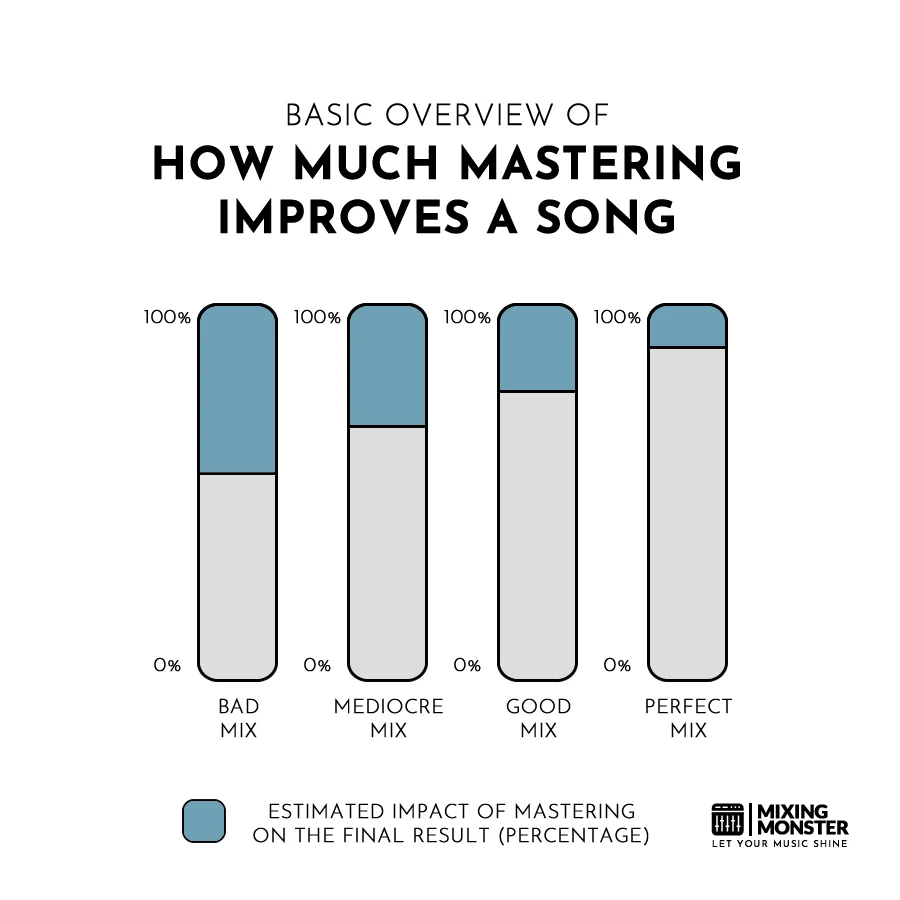
Mastering cannot replace mixing, nor can it save a poorly mixed track. It works exclusively with the stereo mixdown file and applies processing to enhance the overall presentation. A mastering engineer addresses the mix as a complete entity rather than manipulating individual components.
The distinction matters because attempting to fix mixing problems during mastering often creates new issues. For example, boosting treble to brighten dull vocals will also brighten every other element in that frequency range. Achieving the right balance between mixing and mastering is crucial for any successful release.
Proper workflow separates these stages so each receives appropriate attention and expertise. Mastery of both mixing and mastering is what separates amateur recordings from chart-topping hits.

2
Creating Sonic Balance And Consistency Across Your Music
Mastering addresses frequency imbalances and ensures every track shares a unified sonic character. The process involves precise adjustments to tonal balance, dynamic range, and loudness levels so music translates consistently across different playback systems. The primary purpose of mastering is to ensure your artistic vision remains intact across all listening environments.

Achieving Tonal Balance Across The Frequency Spectrum
Equalization in mastering focuses on refining the overall frequency balance of a completed mix. A mastering engineer evaluates the low, mid, and high frequencies to ensure no range dominates or lacks presence.
Common adjustments include:
- Low frequencies (20-250 Hz): Controlling excessive bass that causes muddiness or adding warmth when needed
- Midrange (250-4000 Hz): Reducing harshness or enhancing clarity in vocals and instruments
- High frequencies (4000-20000 Hz): Smoothing brittle treble or adding air and sparkle
Unlike surgical mixing EQ, mastering EQ uses broad, subtle movements typically within 1-3 dB. These gentle adjustments preserve the mix's character while addressing frequency imbalances. Engineers often use linear-phase EQ to avoid phase issues when working with the full stereo mix.
Maintaining Consistency Between Multiple Tracks
Albums and EPs require consistency in sound across all tracks to create a seamless listening experience. Without mastering, individual songs mixed at different times or studios may have varying loudness levels, tonal characteristics, or stereo widths.
A mastering engineer matches perceived loudness using LUFS measurements rather than relying solely on peak levels. They adjust the tonal balance, so one track doesn't sound significantly brighter or darker than another. Dynamic processing ensures similar energy levels between tracks.
Sequencing plays a crucial role in maintaining flow. Engineers determine appropriate gaps between songs and may adjust fade-ins or fade-outs. The goal is to create natural transitions while retaining each track's unique characteristics.
Discover Best Audio Gear & Equipment

Correcting Frequency Imbalances From The Mix Stage
Mixing rooms and monitoring systems introduce sonic biases that mastering can address. A mix created on bass-heavy speakers may lack low-end weight when played on other speakers. Similarly, bright-sounding monitors might result in a dull mix.
Professional mastering brings objectivity through calibrated listening environments and fresh ears. Engineers identify problematic frequency buildups, resonances, or deficiencies missed during mixing. They apply corrective EQ to resolve these issues without compromising the artistic vision.
Mastering cannot fix fundamental mixing problems, such as poorly recorded vocals or buried instruments. The process works best when the mix already sounds balanced. Engineers typically request mixes with adequate headroom and minimal processing on the master bus to maintain flexibility.
Creating A Cohesive Sound For Albums And EPs
A unified sonic identity distinguishes professional albums from collections of disparate tracks. Mastering ensures tonal quality and volume levels remain consistent throughout an entire project.
Engineers establish a reference point using one or two representative tracks, then match remaining songs to that standard. This approach maintains each song's individual character while establishing cohesion. Compression and limiting settings stay similar across tracks to preserve dynamic relationships.
Genre considerations influence mastering decisions. Classical recordings prioritize dynamic range preservation and natural ambience. Electronic music often requires careful attention to bass weight and transient punch. The mastering engineer adapts techniques to suit the musical style while maintaining consistency.
Format preparation represents the final step. Engineers create different masters optimized for streaming platforms, CD, vinyl, or digital downloads. Each format has specific technical requirements regarding loudness targets, sample rates, and file types.
3
Optimizing Loudness Standards For Commercial Release
Achieving optimal loudness for commercial release requires understanding platform-specific normalization systems and industry targets while preserving the musical dynamics that give tracks their emotional impact. Mastering engineers must navigate technical specifications without sacrificing audio quality.

Understanding Loudness Normalization On Streaming Platforms
Streaming services automatically adjust track volumes to provide consistent playback experiences across their catalogs. Spotify, Apple Music, YouTube, and other platforms each implement their own loudness normalization standards, analyzing tracks using LUFS measurements before applying gain adjustments.
When a track exceeds the platform's target loudness, the system reduces its volume. When it falls below the target, no upward adjustment occurs in most cases. This means overly loud masters get turned down while quieter tracks remain at their original level.
Different platforms use varying target levels:
- Spotify: -14 LUFS
- Apple Music: -16 LUFS
- YouTube: -14 LUFS
- Amazon Music: -14 LUFS
- Tidal: -14 LUFS
The key consideration is that pushing a track beyond these targets offers no loudness advantage on normalized platforms. Instead, excessive limiting can reduce dynamic range and introduce distortion that remains audible even after the platform turns the volume down.
Meeting Industry Loudness Standards And LUFS Targets
LUFS (Loudness Units Full Scale) provides the standard measurement for perceived loudness in modern mastering. The integrated LUFS value measures overall loudness across an entire track, making it the primary metric for mastering loudness decisions.
Most commercial releases target -8 to -10 LUFS for competitive genres like pop, rock, and electronic music. Hip-hop often pushes slightly louder to -7 or -8 LUFS. More dynamic genres like jazz, classical, and acoustic music typically master between -12 to -16 LUFS to preserve musical nuance.
Engineers should maintain at least -1 dB true peak headroom to prevent intersample peaks during lossy encoding. True peak limiting catches peaks that occur between digital samples, which standard peak meters miss, but can distort MP3 or AAC conversion.
Using LUFS meters, such as the Youlean Loudness Meter, during the mastering process ensures accurate loudness measurement before distribution. These tools display integrated LUFS alongside short-term and momentary values for comprehensive loudness analysis.
Your Song Mixed & Mastered By Mixing Monster


Avoiding The Loudness War Pitfalls
The loudness war refers to the practice of making recordings progressively louder through heavy compression and limiting. This approach sacrifices dynamic range for perceived volume, often resulting in fatigued, lifeless recordings that lack punch and clarity.
Streaming normalization has largely rendered the loudness war irrelevant. Tracks mastered to -6 LUFS and -14 LUFS play at identical volumes on Spotify, but the -14 LUFS version retains superior dynamics and transient impact.
Over-limiting creates several problems:
- Crushed transients that remove punch from drums and percussive elements
- Pumping artifacts from excessive compression
- Reduced clarity as frequency ranges compete in a limited dynamic space
- Listener fatigue from constant high-level stimulation
Engineers achieve better results by balancing loudness with dynamics rather than maximizing peak levels. A master with 6-8 dB of dynamic range typically sounds more professional than one compressed to 3-4 dB, even at lower LUFS values.
Balancing Loudness With Dynamic Range Preservation
Dynamic range represents the difference between the quietest and loudest parts of a recording. Preserving appropriate dynamic range while achieving competitive loudness levels defines skilled mastering work.
Strategic compression shapes dynamics without destroying them. Multiband compression addresses specific frequency ranges that need control, leaving other bands more dynamic. Parallel compression blends compressed and uncompressed signals, maintaining transient impact while increasing the average level.
Limiting should be the final stage, applied transparently to catch peaks rather than reshape the entire waveform. Modern limiters offer look-ahead functionality that prevents distortion by predicting peaks before they occur. Setting conservative release times helps limiters recover naturally between peaks.
Comparing masters against reference tracks in the same genre provides context for loudness decisions. Well-mastered commercial releases demonstrate how to achieve both competitive levels and engaging dynamics. The goal is to match the perceived impact of professional releases, not simply match their LUFS numbers.
Mastering levels should serve the music's emotional content. A ballad with excessive loudness loses intimacy, while an aggressive rock track mastered too quietly lacks energy. The technical specifications provide guidelines, but musical judgment determines the optimal balance for each project.

4
Ensuring Playback Optimization Across All Listening Environments
A well-mastered track maintains its sonic integrity whether played through professional studio monitors, budget earbuds, or a car audio system. The mastering process requires careful attention to how audio translates across vastly different playback systems to deliver a consistent listening experience.
Translating Your Music Across Different Speaker Systems
Different speaker systems reproduce audio with varying frequency responses and capabilities. High-end studio monitors reveal details that consumer speakers might miss, while smaller speakers struggle to reproduce deep bass frequencies accurately.
Mastering engineers address these differences by ensuring frequency balance remains clear across all systems. This involves careful equalization to prevent bass-heavy mixes from becoming muddy on smaller speakers or overly bright mixes from sounding harsh on quality systems. The goal is to create a mix that adapts well to each system's strengths and limitations.
Professional mastering involves checking the track on multiple reference systems during the process. This includes large monitors, small nearfield speakers, and consumer-grade playback devices to identify potential translation issues before final delivery.
Optimizing For Headphones, Car Stereos, And Home Systems
Each listening environment presents unique acoustic challenges that affect how music is perceived. Headphones provide intimate detail and stereo separation, while car stereos compete with road noise and cabin acoustics. Home systems vary widely in quality and room treatment.
Ensuring consistent sound quality across platforms requires specific adjustments during mastering. Engineers consider how compression affects perceived loudness in noisy environments, such as cars, where excessive dynamic range makes quiet passages difficult to hear. For headphone listening, stereo imaging and low-frequency balance receive particular attention since headphones reveal subtle flaws more readily than speakers.
The mastering process accounts for how different systems handle bass frequencies. Car stereos often emphasize low end, requiring careful control to prevent boomy or overwhelming bass. Home systems with subwoofers need proper low-frequency management to avoid imbalance.
Related Articles

Testing And Verifying Playback On Multiple Devices
Comprehensive testing forms a critical quality control step in the mastering workflow. Engineers systematically evaluate the mastered track across various playback scenarios to identify issues that might affect the listening experience.
A thorough testing protocol includes listening to:
- Professional studio monitors
- Consumer headphones and earbuds
- Smartphone speakers
- Laptop speakers
- Car audio systems
- Bluetooth speakers
This verification process reveals how tracks sound on a range of devices, from high-end speakers to smartphones. Engineers take notes during each listening session, documenting any frequency imbalances, distortion, or clarity issues that emerge on specific systems.
Testing also involves listening at different volume levels, as perceived frequency balance shifts with loudness. A mix that sounds perfect at high volume might lack low-end presence at moderate listening levels.
Addressing Mono Compatibility And Phase Issues
Phase problems and mono compatibility issues can severely compromise how music translates across different playback systems. When stereo information doesn't collapse properly to mono, certain elements can disappear or become noticeably quieter.
Many real-world listening scenarios present mono or near-mono playback. Single smartphone speakers, some PA systems, and certain streaming situations sum stereo tracks to mono. Phase cancellation occurs when the left and right channels contain similar information with slight timing differences, resulting in frequency cancellation when combined.
Mastering engineers use specialized metering tools to identify phase issues before they become problems. They check the mix in mono to ensure all elements remain present and balanced. Corrective measures include adjusting stereo widening effects, realigning phase-inverted signals, and ensuring bass frequencies remain centered and mono-compatible.
Proper phase alignment also prevents listening fatigue and maintains punch in the low end. A phase-coherent master delivers better impact and clarity regardless of whether the listener hears it in stereo or mono.

5
Preparing Masters For Different Distribution Formats
Each distribution format requires specific technical specifications and preparation methods to ensure optimal playback quality. Digital streaming demands different loudness targets than physical media, while vinyl requires unique frequency adjustments that don't apply to CD production.
Creating Digital Masters For Streaming Services
Streaming platforms apply loudness normalization to ensure consistent playback levels across their catalogs. Spotify normalizes to -14 LUFS, while Apple Music targets -16 LUFS. YouTube uses LUFS values between -13 and -15, depending on content type.
Masters should be delivered as high-resolution WAV files, typically 24-bit at 44.1 kHz or 48 kHz. Engineers must leave adequate headroom, usually -1 dB true peak, to prevent clipping during format conversion. Over-compressed masters that exceed platform targets will be automatically turned down, reducing their competitive loudness advantage.
The dynamic range should be preserved since aggressive limiting often sounds worse after normalization. Metadata tagging must include accurate information such as ISRC codes, track titles, and artist names. Most distributors accept WAV or FLAC formats, though MP3 files at 320 kbps may be required for promotional purposes.
Preparing Vinyl Masters With Specific Requirements
Vinyl mastering requires significant technical adjustments due to the format's physical limitations. Low frequencies must be centered in mono below 150 Hz to prevent groove jumping and tracking issues. Excessive sibilance in the 6-10 kHz range can distort playback.
The cutting engineer applies a de-emphasis curve to compensate for the RIAA equalization standard. Bass-heavy material needs special attention since large waveform excursions consume more groove space and reduce available playing time per side. Tracks with extended low-end content may need strategic placement toward the beginning of each side where groove spacing is wider.
Running time affects cut level: sides longer than 20 minutes require quieter cuts to reduce overall volume. Engineers typically provide separate vinyl masters that differ from the digital versions. These masters often feature reduced low-end stereo width and gentler limiting to accommodate the format's constraints.
Mastering For CD Replication And Physical Media
CD masters must conform to the Red Book standard of a 44.1 kHz sample rate and 16-bit depth. The final master is typically delivered as a DDP (Disc Description Protocol) image file or as individual WAV files, each with accompanying PQ codes that define track start times and gaps.
The total running time cannot exceed 79 minutes and 59 seconds. Each track requires proper spacing, usually 2 seconds between songs, though this varies based on artistic intent. ISRC codes must be embedded for each track, and CD-Text information should include album and track titles.
Master wav files should come directly from the mastering session and remain unaltered after bit-depth reduction. Peak levels are typically set to -0.1 to -0.3 dBFS to prevent intersample peaks during digital-to-analog conversion. The audio must be dithered properly when reducing from 24-bit to 16-bit to maintain sound quality and minimize quantization distortion.
Generating Format-Specific Masters For Various Platforms
Different platforms require tailored master versions beyond basic streaming and physical formats. Radio broadcast demands -23 LUFS for European standards or different targets for North American markets. Mastering engineers create multiple versions from the same source material to meet each platform's specifications.
Format requirements vary significantly across distribution channels. Film and television sync licensing often requires stems (separated instrument groups) in addition to stereo masters. Video game audio needs special consideration for loop points and interactive implementation.
|
Format |
Sample Rate |
Bit Depth |
Loudness Target |
|
Streaming |
44.1-48 kHz |
24-bit |
-14 to -16 LUFS |
|
CD |
44.1 kHz |
16-bit |
-0.1 dBFS peak |
|
Mastered for iTunes |
96 kHz |
24-bit |
-16 LUFS |
|
Radio |
48 kHz |
24-bit |
-23 LUFS |
High-resolution download stores like Bandcamp and HDtracks accept 96 kHz or 192 kHz sample rates at 24-bit depth. These formats appeal to audiophile listeners who prefer uncompressed audio. Engineers maintain separate archive masters at the highest resolution possible, typically 96 kHz/24-bit, from which all distribution formats are derived.

6
Quality Control And Technical Problem Solving
The mastering engineer conducts systematic quality checks to identify technical flaws, eliminate unwanted sonic artifacts, optimize track transitions, and validate all embedded metadata before final delivery.
Identifying And Correcting Technical Issues
Mastering engineers analyze audio files for technical problems that could compromise playback quality or prevent distribution. They check sample rate and bit depth specifications to ensure files meet delivery requirements, typically verifying that high-resolution sources maintain their integrity throughout the mastering chain.
Common technical issues include digital clipping, phase cancellation between stereo channels, and DC offset that can reduce headroom. Engineers use metering tools and spectral analysis to detect these problems. They examine the frequency spectrum for anomalies and check stereo imaging for imbalances.
File format errors present another category of technical issues. Corrupted headers, incorrect bit depth conversion, or improper dithering can degrade audio quality. The engineer verifies that sample rate conversions use appropriate algorithms to prevent aliasing or loss of high-frequency content.
Technical proficiency enables engineers to meticulously diagnose quality issues and effectively implement corrective actions.
Removing Unwanted Noise And Artifacts
Noise reduction represents a critical quality control function during mastering. Engineers identify and eliminate background hiss, electrical hum, digital clicks, and other artifacts that distract from the musical content.
Spectral editing tools allow surgical removal of specific frequency ranges where noise occurs without affecting the desired audio. Engineers distinguish between artifacts requiring removal and musical elements that should remain untouched. Low-level tape hiss, vinyl crackle on intentional samples, or ambient room noise captured during recording may warrant different treatment approaches.
Digital artifacts from poor editing, compression algorithms, or plugin processing require careful attention. Zipper noise from automation, aliasing from pitch shifting, or pre-echo from aggressive limiting all demand correction. The engineer applies appropriate processing to restore audio integrity while preserving the artistic intent.
Ensuring Proper Sequencing And Spacing Between Tracks
Track sequencing establishes the flow of listening for albums and EPs. The mastering engineer sets the precise spacing between songs, typically ranging from 0 seconds for continuous mixes to 4 or 5 seconds for standard pop albums.
Crossfade techniques connect tracks that transition without silence. The engineer determines the optimal crossfade duration and curve shape to create smooth transitions. Some genres require specific spacing conventions—classical albums often use longer gaps between movements, while electronic dance music compilations may feature seamless beat-matched transitions.
The engineer considers dynamic contrast and key relationships between adjacent tracks. A quiet, introspective song following an intense track may need additional space for listeners to adjust. Volume level consistency across the sequence prevents jarring changes that disrupt the listening experience.
Verifying Metadata And ISRC Code Implementation
Metadata verification ensures that all text information embedded in audio files appears correctly across distribution platforms and playback systems. The engineer confirms artist names, album titles, track names, and composer credits match the client's specifications exactly.
ISRC (International Standard Recording Code) codes serve as unique identifiers for each track, enabling royalty tracking and sales reporting. The mastering engineer embeds these twelve-character alphanumeric codes into the master files and verifies their accuracy. Each ISRC code contains a country code, a registrant code, a year of reference, and a designation code.
Additional metadata fields include copyright information, UPC/EAN barcodes for albums, genre classifications, and release dates. The engineer checks that all fields comply with format requirements for intended distribution channels. Streaming platforms, download stores, and CD manufacturing facilities each have specific metadata standards that must be met for proper catalog integration.

7
Enhancing Professional Polish And Competitive Sound Quality
Mastering bridges the gap between a finished mix and a commercially viable release by refining audio quality through precise adjustments to frequency balance, dynamics, and stereo imaging. These refinements ensure tracks meet industry loudness standards while preserving the emotional impact that connects listeners to the music.
Adding The Final Layer Of Professional Sheen
Professional sheen comes from carefully applied processing that addresses micro-level imperfections in the frequency spectrum and dynamic range. Engineers use high-quality equalization to smooth out harsh resonances and add subtle brightness, making vocals and instruments more present without sounding artificial.
Compression in mastering differs from mixing compression in that it works across the entire stereo field to create cohesion among all elements. Light compression ratios between 1.2:1 and 2:1 preserve dynamics while adding the glue that makes individual tracks feel like a unified production.
Saturation and harmonic enhancement add warmth and perceived loudness without aggressive limiting. These techniques transform raw mixes by introducing pleasing harmonics that fill out the frequency spectrum and create a fuller sound.
Competing With Major Label Production Standards
Modern streaming platforms require tracks to meet specific loudness targets, typically between -14 LUFS and -9 LUFS, depending on the genre. Professional mastering ensures songs achieve competitive loudness while maintaining dynamic range that prevents listener fatigue.
Reference tracks from major-label releases serve as benchmarks for tonal balance and loudness. Mastering engineers compare their work against successful commercial releases in the same genre to identify gaps in frequency response or dynamic treatment.
The sound quality achieved through proper mastering enables independent artists to compete directly with major-label productions. Strategic use of limiting increases perceived loudness without introducing distortion, ensuring tracks maintain their emotional impact when played alongside chart-topping releases.
Maximizing Clarity And Definition In Your Mix
Clarity emerges when each frequency range occupies its proper space without masking other elements. Mastering techniques address frequency buildup in problematic areas like 200-400 Hz, where muddiness accumulates, and 2-4 kHz, where harshness appears.
Mid/side processing separates center information from stereo content, allowing engineers to enhance vocal clarity without affecting the width of backing instruments. This targeted approach preserves stereo imaging while improving definition in the areas where listeners focus.
Key clarity improvements include:
- Surgical EQ cuts to remove resonances
- Dynamic EQ that responds only when problems occur
- Multiband compression for frequency-specific control
- Stereo widening that maintains mono compatibility
Using Subtle Enhancements To Elevate Your Sound
Subtlety separates professional mastering from amateur over-processing. Small adjustments of 0.5-2 dB in strategic frequency bands create noticeable improvements without obvious processing artifacts. These gentle changes accumulate to yield significant improvements in audio quality.
Stereo enhancement widens the soundstage by increasing the difference between left and right channels in specific frequency ranges. Applying widening only above 200 Hz maintains bass punch while creating space for melodic elements.
Tape emulation and analog modeling plugins introduce subtle harmonic distortion that adds character without degrading transients. These processors replicate the warmth of analog equipment while maintaining the precision of digital workflows, giving tracks a finished quality that feels both modern and timeless.
8
DIY Mastering Versus Professional Mastering Services
The decision between mastering your own tracks and hiring a professional involves evaluating your technical skills, project requirements, and available resources. Each approach offers distinct advantages depending on the complexity of your music and your long-term goals.
When To Master Your Own Music
DIY mastering works best for artists developing their skills or working on less critical releases, such as demos, practice mixes, or social media content. Musicians with a solid understanding of frequency balancing, dynamic processing, and loudness standards can achieve acceptable results with high-quality plugins and proper monitoring equipment. Developing a solid workflow for mixing and mastering at home allows for rapid iteration during the creative process.
Home mastering suits projects where budget constraints prevent hiring professional mastering services—artists who produce frequently and want complete creative control benefit from learning the mastering process themselves. Often, taking a dedicated mastering course provides the technical foundation needed to avoid common beginner errors. However, this approach requires significant time investment and a willingness to study technical aspects like compression ratios, EQ curves, and stereo imaging.
The DIY route demands honest self-assessment. Artists must have access to accurate monitoring in a treated room and understand how to use reference tracks effectively. Those lacking these fundamentals risk creating masters that sound unbalanced on different playback systems. The primary purpose of mastering is to ensure your artistic vision remains intact across all listening environments.
Benefits Of Hiring Professional Mastering Engineers
Professional mastering engineers bring specialized expertise that extends beyond plugin knowledge. They work in acoustically optimized environments with high-end converters, analog equipment, and precisely calibrated monitoring systems that reveal details impossible to hear in typical home studios.
A professional mastering engineer provides an objective analysis of your mix and can identify frequency buildups, phase issues, or dynamic inconsistencies that compromise translation across different playback systems. Their experience with various genres helps them apply appropriate processing techniques that enhance rather than overpower the original mix.
Professional services ensure consistency across albums or EPs, maintaining cohesive sonic characteristics between tracks recorded or mixed at different times. Engineers also optimize masters for specific distribution formats, whether streaming platforms, vinyl, or CD, each requiring different technical specifications.
Understanding The Fresh Ears Advantage
The fresh ears perspective represents one of the most valuable aspects of professional mastering. After spending hours or days mixing a track, producers develop listening fatigue and emotional attachment that clouds their judgment about what the music actually needs.
An external mastering engineer approaches the project without preconceptions or biases. They hear the track as a first-time listener would, identifying problems that become invisible to those too close to the production. This objectivity allows them to make decisions based purely on what serves the music rather than defending creative choices made during recording or mixing.
Fresh ears catch subtle issues like harsh resonances, insufficient low-end control, or stereo imbalances that the original producer might overlook. This unbiased feedback not only improves the current project but also informs future production decisions.
Cost Considerations And Budget-Friendly Options
Professional mastering typically costs between $50 and $200 per track, depending on the engineer's experience and turnaround time. Albums may receive discounted per-track rates. While this represents a significant investment for independent artists, it ensures industry-standard results for important releases, such as singles, albums, or tracks intended for radio play.
DIY mastering eliminates per-track fees but requires upfront investment in software, plugins, and acoustic treatment. Quality mastering tools range from $100 to $500, while room treatment and monitoring improvements add to the cost. Artists must weigh these initial expenses against long-term savings if they plan to release music regularly.
Budget-conscious musicians can explore middle-ground solutions like online mastering services offering lower rates for quick turnarounds, or hiring professionals for singles while DIY mastering B-sides and demos. Some engineers offer feedback-only services, reviewing your DIY master and suggesting improvements, combining learning opportunities with professional guidance at a reduced cost.
9
Essential Mastering Tools And Techniques Used Today
Modern mastering relies on a combination of digital processing tools that shape tonal balance, control dynamics, enhance spatial characteristics, and provide visual feedback for precision work. These techniques work together to achieve professional loudness levels while maintaining clarity and depth across all playback systems.
Equalization Techniques For Final Tonal Shaping
Equalization serves as the foundation for tonal correction and enhancement in mastering. Engineers use equalizers to address frequency imbalances that affect how music translates across different listening environments. Broad EQ moves typically work better than narrow cuts because they maintain a natural sound while correcting issues inherited from the mix.
Most mastering engineers apply subtle adjustments rather than dramatic changes. A high-pass filter around 30Hz removes unnecessary subsonic information, freeing up headroom. Gentle boosts in the presence region between 2-5kHz can add clarity to vocals and instruments.
Professional mastering tips emphasize that frequency adjustments should enhance emotional impact rather than simply correct numbers on a spectrum analyzer. The best EQ decisions come from critical listening that considers genre standards and artistic intent.
Linear-phase equalizers prevent phase shifts that can degrade stereo imaging, though they introduce latency. Minimum phase EQs sound more natural for certain materials. Engineers choose between these options based on each project's specific needs.
Compression And Limiting For Loudness Control
Compression in mastering differs significantly from mix-stage compression. Mastering compression uses gentle ratios between 1.5:1 and 3:1 with slow attack and release times to control dynamics without audibly pumping. This processing glues elements together while preserving transient information that gives music its punch and excitement.
Multiband compression allows frequency-specific dynamic control. Engineers might tame excessive low-end movement without affecting midrange vocal dynamics. This targeted approach maintains balance across the frequency spectrum while preventing any single range from dominating.
Limiting represents the final stage of loudness maximization. Modern limiters use sophisticated algorithms to increase perceived volume while minimizing distortion. Peak limiters catch transients that would otherwise cause clipping during format conversion or streaming.
Engineers must balance competitive loudness with dynamic range preservation. Excessive limiting creates fatigue and reduces emotional impact. Understanding and mastering tools and techniques helps engineers achieve appropriate loudness for each genre and distribution platform.
Stereo Width Enhancement And Imaging Tools
Stereo imaging tools modify the spatial presentation of music without compromising mono compatibility. Engineers analyze stereo width to ensure low frequencies remain centered while higher frequencies can occupy the full stereo field. This approach prevents phase cancellation issues in mono playback systems such as smartphones and smart speakers.
Mid-side processing separates center information from side information. Engineers can widen backing vocals in the sides while keeping lead vocals and bass focused in the center. This technique creates space and depth without making the mix feel disconnected.
Stereo enhancement plugins must be used carefully, as excessive widening can introduce phase problems. The correlation meter shows the relationship between left and right channels. Values near +1 indicate good mono compatibility, while negative values signal potential cancellation.
Some genres benefit from wider stereo images while others require a more focused presentation. Electronic music often features a wide soundstage, while jazz recordings typically maintain a more natural soundstage that mimics live performance spaces.
Metering And Analysis Software For Precision
Digital audio workstations include essential metering tools that provide visual feedback during mastering. LUFS meters measure integrated loudness in accordance with streaming platform specifications. True peak meters detect inter-sample peaks that digital-to-analog converters might distort even when the signal stays below 0 dBFS.
| Meter Type | Purpose | Target Range |
| LUFS | Integrated loudness | -14 to -8 LUFS depending on platform |
| True Peak | Inter-sample peaks | -1.0 dBTP maximum |
| Correlation | Stereo compatibility | +0.5 to +1.0 |
Spectrum analyzers display frequency content across the audible range. Engineers compare their masters against reference tracks to identify tonal imbalances. However, critical listening skills remain more important than matching frequency curves exactly.
Phase correlation meters reveal potential mono compatibility issues. Dynamic range meters show the difference between the loudest and quietest moments. Together, these tools provide objective data that complements subjective listening decisions made by experienced mastering engineers.
10
Common Mastering Mistakes To Avoid
Mastering engineers frequently encounter tracks that suffer from preventable issues introduced during mixing or premature mastering attempts. Understanding these pitfalls helps producers deliver material that can be transformed into polished, professional releases.

Over-Processing And Destroying Mix Dynamics
Excessive compression ranks among the most damaging mastering mistakes producers make when attempting to maximize loudness. When engineers apply aggressive compression ratios above 3:1 with fast attack times, they crush the natural peaks and valleys that give music its emotional impact.
The dynamic range between soft and loud passages creates tension and release in musical arrangements. Over-compressed tracks lose this contrast, resulting in listener fatigue within minutes. Many producers also fall into the trap of stacking multiple compressors without understanding their cumulative effect on transients.
Signs of over-processing include:
- Pumping or breathing artifacts in sustained notes
- Loss of punch in drum hits
- Flattened vocal expression
- Distortion on peaks despite proper gain staging
Transparent compression with ratios between 1.5:1 and 2:1 preserves dynamics while adding cohesion. Engineers should prioritize slow attack times above 30ms to allow transients through and release times that match the song's tempo. EQ adjustments require similar restraint—broad cuts and boosts of 2-3dB typically suffice, while narrow surgical moves often introduce phase problems that weaken the stereo image.
Ignoring the Listening Environment Acoustics
Room acoustics profoundly affect mastering decisions, yet many engineers work in untreated spaces with significant frequency buildup or nulls. Bass frequencies below 200Hz interact strongly with room dimensions, creating standing waves that exaggerate or diminish low-end content in the mix.
Without acoustic treatment, engineers compensate for room issues rather than addressing actual mix problems. Someone working in a room with 6dB of buildup at 80Hz might cut that frequency unnecessarily, resulting in thin-sounding masters on other playback systems. Corner bass traps and broadband absorption panels help control reflections and frequency response.
Monitoring at consistent, moderate volumes between 75-85dB SPL prevents both ear fatigue and distortions on the Fletcher-Munson curve. Multiple listening positions within the room reveal how bass response and stereo imaging change with location. Engineers should also verify their work on multiple speaker systems, including headphones, car audio, and consumer earbuds, to catch issues that room acoustics might mask.
Rushing The Mastering Process Without Reference Tracks
Working without reference tracks removes the objective benchmark needed to evaluate tonal balance and competitive loudness levels. Professional mastering engineers routinely A/B their work against commercial releases in the same genre, level-matching to around -14 LUFS for fair comparison.
Reference tracks provide concrete examples of how low-end extension, midrange clarity, and high-frequency air should sound on calibrated monitoring systems. They also reveal appropriate loudness targets—electronic dance music typically lands between -8 and -6 LUFS integrated, while indie rock often sits around -10 to -9 LUFS.
Taking breaks every 45-60 minutes helps prevent ear fatigue, which degrades critical listening ability. Fresh ears notice harshness, muddiness, and imbalance that become normalized after extended sessions. Many engineers also master the tracks the day after mixing to gain perspective.
The panning and reverb choices made during mixing become clearer with temporal distance, allowing better judgment about whether spatial elements need adjustment during mastering.
Failing To Provide Proper Headroom For The Mastering Engineer
Mixes that peak at 0 dBFS or use limiting on the master bus limit the mastering engineer's ability to apply proper processing. Professional mastering requires at least 3-6dB of headroom, with peaks ideally hitting between -6 and -3 dBFS on the loudest sections.
Pre-mastering checklist for mix exports:
- Remove all limiting, maximizing, or "mastering" plugins from the master bus
- Ensure 32-bit float or 24-bit export resolution
- Maintain the original sample rate used during production
- Export with no dithering applied
- Verify no digital clipping occurs throughout the track
Headroom allows the mastering engineer to apply makeup gain after compression without exceeding the digital ceiling. It also provides flexibility for EQ boosts that might otherwise cause clipping. Some producers mistakenly believe louder mixes give mastering engineers better material, but the opposite proves true—dynamics and clean peaks enable superior results.
Reverb tails and ambient elements require particular attention during mixing, as excessive reverb can muddy the low end and reduce available headroom. Producers should also check their panning decisions before export, ensuring mono compatibility and avoiding phase cancellation that mastering cannot fix.
11
Key Takeaways For Understanding The Purpose Of Mastering
Mastering represents the final stage of skill development where proficiency becomes second nature. It involves deep understanding rather than simple memorization or mechanical repetition.
The journey toward mastering anything requires dedication, patience, and consistency throughout the learning process. Progress unfolds gradually through deliberate practice focused on areas for improvement.
Core Elements of Mastery:
- Continuous refinement - Skills improve through ongoing practice and learning
- Deep comprehension - Understanding principles behind actions, not just executing them
- Adaptability - Applying knowledge across different situations and contexts
Mastering a skill deepens self-understanding, fosters discipline, and opens doors to unexpected opportunities. These benefits extend beyond the specific skill being developed.
The process physically changes neural pathways in the brain through neuroplasticity. Repeated practice strengthens these connections, making actions feel more automatic over time.
Common Misconceptions:
| Myth | Reality |
| Mastery means perfection | Progress matters more than perfection |
| Natural talent is required | Hard work and dedication outweigh innate ability |
| Mastery has a finish line | Growth continues indefinitely |
Mastering helps individuals set goals and work toward them with focus and intentionality. The qualities developed during this journey—discipline, resilience, and focus—transfer to other areas of life, enhancing overall capability and confidence.
Happy mastering!

Frequently Asked Questions
1
What are the benefits of audio mastering for a music track?
Audio mastering ensures tracks translate correctly across different playback systems, from studio monitors to phone speakers. The process optimizes frequency balance, dynamic range, and stereo imaging to achieve professional sound quality. Beyond just volume, the purpose of mastering is to provide technical quality control for every release.
Mastering engineers check for technical issues like clicks, distortion, and phase problems that might compromise playback. They ensure mono compatibility, so tracks don't collapse or lose important elements when played on single-speaker systems.
The process applies EQ adjustments, compression, and limiting to achieve appropriate loudness levels while preserving musical dynamics. Genre-specific frequency optimization ensures tracks match industry standards for their musical category.
2
How does mastering differ from mixing in the production process?
Mixing balances individual recorded tracks and creates the stereo mix file. Mastering processes that completed the stereo mix to prepare it for distribution and commercial release.
Mastering cannot replace or fix fundamental problems in a poorly executed mix. The mixing stage handles panning, individual track levels, and effects processing, while mastering focuses on the overall sonic characteristics of the finished stereo file. Both mixing and mastering are essential for a polished sound, but they focus on different levels of sonic detail.
Mastering also addresses consistency across multiple tracks in an album. The process ensures uniform volume and tonal balance between songs while maintaining each track's unique character.
3
What role does AI play in the modern mastering of music?
AI-powered mastering tools analyze audio files and apply automated processing in line with genre conventions and loudness standards. These platforms offer quick, affordable alternatives to traditional mastering services for independent artists with limited budgets. While these services help beginners learn what mastering is, they often lack the critical ear of a human professional.
Machine learning algorithms can identify frequency imbalances and suggest corrections for common technical issues. However, AI systems lack the creative judgment and nuanced decision-making that experienced human engineers bring to projects.
Professional mastering engineers still provide superior results for commercial releases by applying context-specific adjustments. They understand artistic intent and can make creative choices that automated systems cannot replicate.
4
How does mastering impact the distribution of music on platforms like Spotify?
Streaming platforms apply loudness normalization to create consistent playback levels across different tracks. Mastering engineers account for these platform-specific requirements when processing files for digital distribution.
Properly mastered tracks maintain competitive loudness without excessive compression, which can cause listener fatigue. Engineers optimize dynamic range to work within streaming service specifications while preserving musical impact.
Different platforms use varying loudness targets and file format requirements. Mastering addresses these technical specifications to ensure tracks perform optimally across multiple distribution channels.
5
Why might some artists choose not to master their music?
Some artists skip mastering due to budget constraints or a misunderstanding of its importance in the production process. This decision typically results in tracks that sound unprofessional compared to commercially released music.
Unmastered tracks often exhibit technical problems, inconsistent loudness, and poor translation across different playback systems. The lack of proper mastering leads to issues such as phase problems and frequency imbalances that become apparent across different devices.
Beginning producers sometimes believe mastering is optional or unnecessary for demos and rough releases. However, even test releases benefit from basic mastering to ensure proper playback and listener experience.
6
What specialized services do mastering engineers provide for optimal sound quality?
Mastering engineers use calibrated monitoring environments and specialized equipment designed specifically for final audio processing. They provide an objective assessment of mixes using professionally treated rooms and high-quality reference speakers.
Engineers offer format-specific preparation for different distribution methods, including CD, vinyl, and digital platforms. They create DDP files for CD manufacturing and optimize masters for vinyl cutting requirements.
Stem mastering allows engineers to process consolidated instrument groups separately during the mastering stage. This approach provides additional control over the final balance without returning to the full mixing session.